伽玛暴(Gamma-Ray Burst)笔记。记录有关伽玛暴的新文章,另外也包括看的老文章、自己的想法、以及跟天文相关的一些东西。 Feel free to leave me a message by comments or by email.

显示标签为“1.7 clasification”的博文。显示所有博文

星期五, 二月 07, 2014

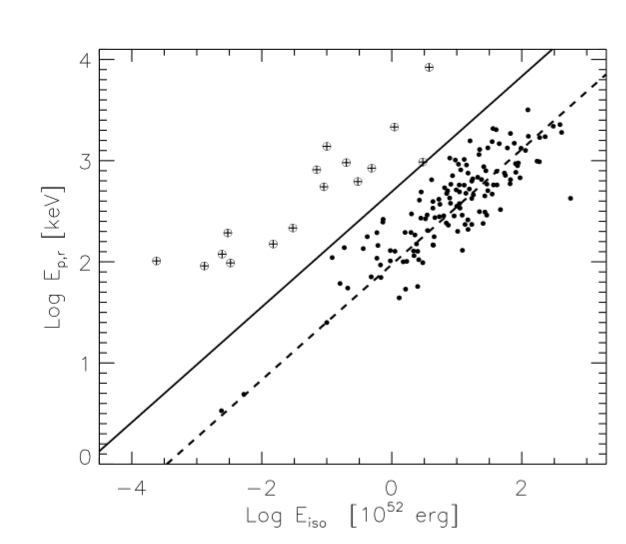
Qin, Yi-Ping 2014 以是否满足Amati关系为标准对伽马暴分类

主要内容:
是满足两个不同系数的Amati关系。

精彩摘抄:


文章信息:
· Find Similar Abstracts (with default settings below)
· Electronic Refereed Journal Article (HTML)
· Full Refereed Journal Article (PDF/Postscript)
· arXiv e-print (arXiv:1311.4713)
· References in the article
· Citations to the Article (1) (Citation History)
· Refereed Citations to the Article
· SIMBAD Objects (154)
· Also-Read Articles (Reads History)
·
· Translate This Page
Title:
Statistical classification of gamma-ray bursts based on the Amati relation
Authors:
Qin, Yi-Ping; Chen, Zhi-Fu
Affiliation:
AA(Center for Astrophysics, Guangzhou University, Guangzhou 510006, China; Department of Physics and Telecommunication Engineering, Baise University, Baise, Guangxi 533000, China; Physics Department, Guangxi University, Nanning 530004, China; ypqin@126.com), AB(Center for Astrophysics, Guangzhou University, Guangzhou 510006, China; Department of Physics and Telecommunication Engineering, Baise University, Baise, Guangxi 533000, China)
Publication:
Monthly Notices of the Royal Astronomical Society, Volume 430, Issue 1, p.163-173 (MNRAS Homepage)
Publication Date:
03/2013
Origin:
OUP
Astronomy Keywords:
methods: statistical, gamma-ray burst: general, stars: late-type, stars: massive, supernovae: general, gamma-rays: general
Abstract Copyright:
2013 The Authors Published by Oxford University Press on behalf of the Royal Astronomical Society
DOI:
10.1093/mnras/sts547
Bibliographic Code:
2013MNRAS.430..163Q

Abstract

Gamma-ray bursts (GRBs) are believed to belong to two classes and they are conventionally divided according to their durations. This classification scheme is not satisfied due to the fact that duration distributions of the two classes are heavily overlapped. We collect a new sample (153 sources) of GRBs and investigate the distribution of the logarithmic deviation of the Ep value from the Amati relation. The distribution possesses an obvious bimodality structure and it can be accounted for by the combination of two Gaussian curves. Based on this analysis, we propose to statistically classify GRBs in the well-known Ep versus Eiso plane with the logarithmic deviation of the Ep value. This classification scheme divides GRBs into two groups: Amati type bursts and non-Amati type bursts. While Amati type bursts follow the Amati relation, non-Amati type bursts do not. It shows that most Amati type bursts are long duration bursts and the majority of non-Amati type bursts are short duration bursts. In addition, it reveals that Amati type bursts are generally more energetic than non-Amati type bursts. An advantage of the new classification is that the two kinds of burst are well distinguishable and therefore their members can be identified in certainty.

Bibtex entry for this abstract   Preferred format for this abstract (see Preferences)

星期二, 二月 07, 2012

Hascoët, R. 2011 "裸暴"可能并不裸

主要内容:
“裸暴”是没有余辉的暴,一般认为是外部介质密度非常低,所以叫裸暴。
文章讨论了如果密度非常高,也会看不到余辉。

精彩摘抄:


文章信息:

· Find Similar Abstracts (with default settings below)
· Electronic Refereed Journal Article (HTML)
· Full Refereed Journal Article (PDF/Postscript)
· arXiv e-print (arXiv:1109.4514)
· References in the article
· SIMBAD Objects (8)
· Also-Read Articles (Reads History)
·
· Translate This Page
Title:
Was the "naked burst" GRB 050421 really naked?
Authors:
Hascoët, R.; Uhm, Z. L.; Mochkovitch, R.; Daigne, F.
Affiliation:
AA(Institut d'Astrophysique de Paris, UMR 7095 Université Pierre et Marie Curie-Paris 6 - CNRS, 98 bis boulevard Arago, 75014, Paris, France hascoet@iap.fr), AB(Institut d'Astrophysique de Paris, UMR 7095 Université Pierre et Marie Curie-Paris 6 - CNRS, 98 bis boulevard Arago, 75014, Paris, France), AC(Institut d'Astrophysique de Paris, UMR 7095 Université Pierre et Marie Curie-Paris 6 - CNRS, 98 bis boulevard Arago, 75014, Paris, France mochko@iap.fr)
Publication:
Astronomy & Astrophysics, Volume 534, id.A104 (A&A Homepage)
Publication Date:
10/2011
Origin:
EDP Sciences
Astronomy Keywords:
radiation mechanisms: non-thermal, gamma-ray burst: general, gamma-ray burst: individual: GRB 050421, shock waves
DOI:
10.1051/0004-6361/201117404
Bibliographic Code:
2011A&A...534A.104H

Abstract

Context. A few long gamma-ray bursts such as GRB 050421 show no afterglow emission beyond the usual initial steep decay phase. It has been suggested that these events correspond to "naked" bursts that occur in a very low density environment. We reconsider this possibility in the context of various scenarios for the origin of the afterglow. 
Aims: In the standard model where the afterglow results from the forward shock as well as in the alternative model where the afterglow comes from the reverse shock, we aim to obtain constraints on the density of the environment, the microphysics parameters, or the Lorentz factor of the ejecta, which are imposed by the absence of a detected afterglow. 
Methods: For the two models we compute the afterglow evolution for different values of the external density (uniform or wind medium) and various burst parameters. We then compare our results to the Swift data of GRB 050421, which is the best example of a long burst without afterglow. 
Results: In the standard model we show that consistency with the data imposes that the external density does not exceed 10-5 cm-3 or that the microphysics parameters are very small with ɛe ≲ 10-2 and ɛB ≲ 10-4. If the afterglow is caused by the reverse shock, we find that its contribution can be strongly reduced if the central source has mainly emitted fast-moving material (with less than 10-30% of the kinetic energy at Γ < 100) and was located in a dense environment. 
Conclusions: The two considered scenarios therefore lead to opposite constraints on the circumburst medium. The high-density environment, favored by the reverse shock model, better corresponds to what is expected if the burst progenitor was a massive star.
Bibtex entry for this abstract   Preferred format for this abstract (see Preferences)

星期日, 二月 05, 2012

Lazzati, Davide 2011 用中心引擎的持续时间来分类伽马暴Ibc型超新星等

主要内容:
假设中心引擎的持续时间就是能产生喷流的时间,考虑到喷流还要穿过恒星包层,那么喷流时间最长的能产生正常的长伽马暴;中等长度的只能产生如GRB 980425样的弱伽马暴;短的只产生超新星,不过这种超新星的速度蛮快的;最短的,就只有一个一般的超新星,而没有任何伽马暴的特征了。

精彩摘抄:


文章信息:
· Find Similar Abstracts (with default settings below)
· arXiv e-print (arXiv:1111.0970)
· References in the Article
· Citations to the Article (1) (Citation History)
· Refereed Citations to the Article
· Also-Read Articles (Reads History)
·
· Translate This Page
Title:
Unifying the Zoo of Jet-Driven Stellar Explosions
Authors:
Lazzati, Davide; Morsony, Brian J.; Blackwell, Christopher H.; Begelman, Micthell C.
Publication:
eprint arXiv:1111.0970
Publication Date:
11/2011
Origin:
ARXIV
Keywords:
Astrophysics - High Energy Astrophysical Phenomena, Astrophysics - Cosmology and Extragalactic Astrophysics, Astrophysics - Solar and Stellar Astrophysics
Comment:
8 pages, 5 figures, submitted to ApJL. Full resolution version of Fig. 1 available at http://grb.physics.ncsu.edu/ms_hr.pdf
Bibliographic Code:
2011arXiv1111.0970L

Abstract

We present a set of numerical simulations of stellar explosions induced by relativistic jets emanating from a central engine sitting at the center of compact, dying stars. We explore a wide range of durations of the central engine activity, two candidate stellar progenitors, and two possible values of the total energy release. We find that even if the jets are narrowly collimated, their interaction with the star unbinds the stellar material, producing a stellar explosion. We also find that the outcome of the explosion can be very different depending on the duration of the engine activity. Only the longest-lasting engines result in successful gamma-ray bursts. Engines that power jets only for a short time result in relativistic supernova explosions, akin to observed engine-driven SNe such as SN2009bb. Engines with intermediate durations produce weak gamma-ray bursts, with properties similar to nearby bursts such as GRB 980425. Finally, we find that the engines with the shortest durations, if they exist in nature, produce stellar explosions that lack sizable amounts of relativistic ejecta and are therefore dynamically indistinguishable from ordinary core-collapse supernovae.

Bibtex entry for this abstract   Preferred format for this abstract (see Preferences)

星期四, 二月 02, 2012

Zhang, Fu-Wen 2012 Fermi暴的长短暴统计

主要内容:


精彩摘抄:


文章信息:

· Find Similar Abstracts (with default settings below)
· arXiv e-print (arXiv:1201.1549)
· References in the Article
· Also-Read Articles (Reads History)
·
· Translate This Page
Title:
Revisiting the Long/Soft-Short/Hard Classification of Gamma-Ray Bursts in the Fermi Era
Authors:
Zhang, Fu-Wen; Shao, Lang; Yan, Jing-Zhi; Wei, Da-Ming
Publication:
eprint arXiv:1201.1549
Publication Date:
01/2012
Origin:
ARXIV
Keywords:
Astrophysics - High Energy Astrophysical Phenomena
Comment:
26 pages, 9 figures
Bibliographic Code:
2012arXiv1201.1549Z

Abstract

We perform a statistical analysis of the temporal and spectral properties of the latest Fermi gamma-ray bursts (GRBs) to revisit the classification of GRBs. We find that the bimodalities of duration and the energy ratio (Epeak/Fluence) and the anti-correlation between spectral hardness (hardness ratio (HR), peak energy and spectral index) and duration (\Delta T) support the long/soft-short/hard classification scheme for Fermi GRBs. The HR - \Delta T anti-correlation strongly depends upon the spectral shape of GRBs and energy bands, and the bursts with the curved spectra in the typical BATSE energy bands show a tighter anti-correlation than those with the power-law spectra in the typical BAT energy bands. This might explain why the HR - \Delta T correlation is not evident for those GRB samples detected by instruments with a narrower/softer energy bandpass. We also analyze the intrinsic energy correlation for the GRBs with measured redshift and well defined peak energies. The current sample suggests Ep,rest=2455 \times (Eiso/10^{52})^{0.59} for short GRBs, significantly different from that for long GRBs. However, both the long and short GRBs comply with the same Ep,rest-Liso correlation.
Bibtex entry for this abstract   Preferred format for this abstract (see Preferences)

星期六, 七月 09, 2011

Bromberg 2011 低光度暴的起源可能不同

主要内容:
在六个有谱确定的超新星/伽马暴中,有四个GRB980425 (SN1998bw), GRB031203 (SN2003lw), GRB060218 (SN2006aj) and GRB100316D(SN2010bh)属于低光度的暴,他们的起源可能和一般长暴不同,可能是来自shock breakout

精彩摘抄:


文章信息:

· Find Similar Abstracts (with default settings below)
· arXiv e-print (arXiv:1107.1346)
· References in the Article
·
· Translate This Page
Title:
Are low luminosity GRBs generated by relativistic jets?
Authors:
Bromberg, Omer; Nakar, Ehud; Piran, Tsvi
Publication:
eprint arXiv:1107.1346
Publication Date:
07/2011
Origin:
ARXIV
Keywords:
Astrophysics - High Energy Astrophysical Phenomena
Comment:
Submitted to ApJ letters. 12 pages, 1 figure
Bibliographic Code:
2011arXiv1107.1346B

Abstract

Low luminosity gamma-ray bursts (ll-GRBs) constitute a sub-class of gamma-ray bursts (GRBs) that plays a central role in the GRB-supernova connection. While ll-GRBs differ from typical long GRBs (LGRBs) in many aspects, they also share some common features. Therefore, the question whether the gamma-ray emission of ll-GRBs and LGRBs has a common origin is of great interest. Here we address this question by testing whether ll-GRBs, like LGRBs according to the Collapsar model, can be generated by relativistic jets that punch holes in the envelopes of their progenitor stars. The collapsar model predicts that the durations of most observed bursts will be comparable to, or longer than, the time it takes the jets to breakout of the star. We calculate the jet breakout times of ll-GRBs and compare them to the observed durations. We find that there is a significant access of ll-GRBs with durations that are much shorter than the jet breakout time and that these are inconsistent with the Collapsar model. We conclude that the processes that dominate the gamma-ray emission of ll-GRBs and of LGRBs are most likely fundamentally different.

Bibtex entry for this abstract   Preferred format for this abstract (see Preferences)

星期六, 七月 02, 2011

Bucciantini 2011 部分有延展辐射的短暴可能是磁星

主要内容:
考虑这种磁星起源的喷流及其准直。

精彩摘抄:


文章信息:

· Find Similar Abstracts (with default settings below)
· arXiv e-print (arXiv:1106.4668)
· References in the Article
· Also-Read Articles (Reads History)
·
· Translate This Page
Title:
Short GRBs with Extended Emission from Magnetar Birth: Jet Formation and Collimation
Authors:
Bucciantini, N.; Metzger, B. D.; Thompson, T. A.; Quataert, E.
Publication:
eprint arXiv:1106.4668
Publication Date:
06/2011
Origin:
ARXIV
Keywords:
Astrophysics - High Energy Astrophysical Phenomena
Comment:
10 pages, 5 figures, submitted to MNRAS
Bibliographic Code:
2011arXiv1106.4668B

Abstract

Approximately 1/4-1/2 of short duration Gamma-Ray Bursts are followed by variable X-ray emission lasting ~ 100 s with a fluence comparable or exceeding that of the initial burst itself. The long duration and significant energy of this `extended emission'(EE) poses a major challenge to the standard binary neutron star merger model. metzger08 recently proposed that the EE is powered by the spin-down of a strongly magnetized neutron star. However, the effects of surrounding material on the magnetar outflow have not yet been considered. Here we present time-dependent axisymmetric relativistic magnetohydrodynamic simulations of the interaction of the relativistic proto-magnetar wind with a surrounding 10^-1 10^-3 M_\odot envelope, which represents material ejected during the merger; the supernova following AIC; or via outflows from the accretion disk. The collision between the relativistic magnetar wind and the expanding ejecta produces a magnetized nebula inside the ejecta. A strong toroidal magnetic field builds up in the nebula, which drives a bipolar jet out through the ejecta, similar to the magnetar model developed in the case of long duration GRBs. We quantify the `break-out' time and opening angle of the jet theta_j as a function of the wind energy flux dot{E} and ejecta mass M_ej. We show that dot{E} and theta_j are inversely correlated, such that the beaming-corrected (isotropic) luminosity of the jet is primarily a function of M_ej. Both variability arguments, and the lower limit on the power of magnetar outflows capable of producing bright emission, suggest that the true opening angle of the magnetar jet must be relatively large. The model thus predicts a class of events for which the EE is observable with no associated short GRB. These may appear as long-duration GRBs or X-Ray Flashes, which may be detected by future all-sky X-ray survey missions.
Bibtex entry for this abstract   Preferred format for this abstract (see Preferences)

星期四, 十月 21, 2010

Qin 2010 伽马暴的softness分布

主要内容:
长短暴分类一般用hardness-T90, 他们用softness-T90. 结果貌似差不多。

精彩摘抄:


文章信息:

· Find Similar Abstracts (with default settings below)
· Electronic Refereed Journal Article (HTML)
· arXiv e-print (arXiv:1010.1454)
· References in the article
· Also-Read Articles (Reads History)
·
· Translate This Page
Title:
Duration distributions for different softness groups of gamma-ray bursts
Authors:
Qin, Yiping; Gupta, A. C.; Fan, Junhui; Su, Chengyue; Lu, Ruijing
Affiliation:
AA(Center for Astrophysics, Guangzhou University; Physics Department, Guangxi University), AB(Aryabhatta Research Institute of Observational Sciences (ARIES)), AC(Center for Astrophysics, Guangzhou University), AD(Department of Physics, Guangdong Industry University), AE(Physics Department, Guangxi University)
Publication:
Science China Physics, Mechanics and Astronomy, Volume 53, Issue 7, pp.1375-1382 (ScChG Homepage)
Publication Date:
07/2010
Origin:
SPRINGER
Keywords:
gamma-rays, bursts: methods, data analysis: methods, statistical
Abstract Copyright:
(c) 2010: Science China Press and Springer-Verlag Berlin Heidelberg
DOI:
10.1007/s11433-010-4023-0
Bibliographic Code:
2010ScChG..53.1375Q

Abstract

Gamma-ray bursts (GRBs) are divided into two classes according to their durations. We investigate if the softness of bursts plays a role in the conventional classification of the objects. We employ the BATSE (Burst and Transient Source Experiment) catalog and analyze the duration distributions of different groups of GRBs associated with distinct softness. Our analysis reveals that the conventional classification of GRBs with the duration of bursts is influenced by the softness of the objects. There exists a bimodality in the duration distribution of GRBs for each group of bursts and the time position of the dip in the bimodality histogram shifts with the softness parameter. Our findings suggest that the conventional classification scheme should be modified by separating the two well-known populations in different softness groups, which would be more reasonable than doing so with a single sample. According to the relation between the dip position and the softness parameter, we get an empirical function that can roughly set apart the short-hard and long-soft bursts: SP = (0.100 ± 0.028) T {90/‑ (0.85 ± 0.18)}, where SP is the softness parameter adopted in this paper.
Bibtex entry for this abstract   Preferred format for this abstract (see Preferences)

Veres, P. 2010 所谓的第三类伽马暴可能是X射线闪

主要内容:


精彩摘抄:

下面的是第三类


文章信息:


· Find Similar Abstracts (with default settings below)
· arXiv e-print (arXiv:1010.2087)
· References in the Article
· Also-Read Articles (Reads History)
·
· Translate This Page
Title:
A distinct peak-flux distribution of the third class of gamma-ray bursts: A possible signature of X-ray flashes?
Authors:
Veres, P.; Bagoly, Z.; Horváth, I.; Mészáros, A.; Balázs, L. G.
Publication:
eprint arXiv:1010.2087
Publication Date:
10/2010
Origin:
ARXIV
Keywords:
Astrophysics - High Energy Astrophysical Phenomena, Astrophysics - Cosmology and Extragalactic Astrophysics
Comment:
accepted for publication in ApJ
Bibliographic Code:
2010arXiv1010.2087V

Abstract

Gamma-ray bursts are the most luminous events in the Universe. Going beyond the short-long classification scheme we work in the context of three burst populations with the third group of intermediate duration and softest spectrum. We are looking for physical properties which discriminate the intermediate duration bursts from the other two classes. We use maximum likelihood fits to establish group memberships in the duration-hardness plane. To confirm these results we also use k-means and hierarchical clustering. We use Monte-Carlo simulations to test the significance of the existence of the intermediate group and we find it with 99.8% probability. The intermediate duration population has a significantly lower peak-flux (with 99.94% significance). Also, long bursts with measured redshift have higher peak-fluxes (with 98.6% significance) than long bursts without measured redshifts. As the third group is the softest, we argue that we have {related} them with X-ray flashes among the gamma-ray bursts. We give a new, probabilistic definition for this class of events.
Bibtex entry for this abstract   Preferred format for this abstract (see Preferences)

星期二, 九月 14, 2010

Goldstein 2010 伽马暴的一种新的分类方法:E_P/Fluence

主要内容:


精彩摘抄:

灰色的是“短暴“


文章信息:

· Find Similar Abstracts (with default settings below)
· Electronic Refereed Journal Article (HTML)
· Full Refereed Journal Article (PDF/Postscript)
· arXiv e-print (arXiv:1009.2105)
· References in the article
·
· Translate This Page
Title:
A New Discriminator for Gamma-ray Burst Classification: The E peak-fluence Energy Ratio
Authors:
Goldstein, Adam; Preece, Robert D.; Briggs, Michael S.
Affiliation:
AA(Physics Department, The University of Alabama in Huntsville, Huntsville, AL 35809, USA), AB(Physics Department, The University of Alabama in Huntsville, Huntsville, AL 35809, USA), AC(Physics Department, The University of Alabama in Huntsville, Huntsville, AL 35809, USA)
Publication:
The Astrophysical Journal, Volume 721, Issue 2, pp. 1329-1332 (2010). (ApJ Homepage)
Publication Date:
10/2010
Origin:
IOP
ApJ Keywords:
gamma-ray burst: general, methods: data analysis
DOI:
10.1088/0004-637X/721/2/1329
Bibliographic Code:
2010ApJ...721.1329G

Abstract

Using the derived gamma-ray burst (GRB) E peak and fluences from the complete BATSE 5B Spectral Catalog, we study the ensemble characteristics of the E peak-fluence relation for GRBs. This relation appears to be a physically meaningful and insightful fundamental discriminator between long and short bursts. We discuss the results of the lower limit test of the E peak-E iso relations in the E peak-fluence plane for Burst And Transient Source Experiment bursts with no observed redshift. Our results confirm the presence of two GRB classes as well as heavily suggesting two different GRB progenitor types.
Bibtex entry for this abstract   Preferred format for this abstract (see Preferences)

星期一, 八月 23, 2010

Huja 2010 在Swift暴中找第三类

主要内容:


精彩摘抄:


文章信息:


· Find Similar Abstracts (with default settings below)
· arXiv e-print (arXiv:1004.3420)
· References in the article
· Also-Read Articles (Reads History)
·
· Translate This Page
Title:
A Search for the Intermediate Subgroup of Gamma-Ray Bursts in the Swift Dataset
Authors:
Huja, D.; Řípa, J.
Affiliation:
AA(Charles University, Faculty of Mathematics and Physics, Astronomical Institute, V Holešovičkách 2, 180 00 Prague 8, Czech Republic; david.huja@seznam.cz), AB(Charles University, Faculty of Mathematics and Physics, Astronomical Institute, V Holešovičkách 2, 180 00 Prague 8, Czech Republic)
Publication:
Baltic Astronomy, Vol. 18, p. 311-315
Publication Date:
00/2009
Origin:
BALTA
Keywords:
gamma-rays: bursts
Bibliographic Code:
2009BaltA..18..311H

Abstract

We have searched for the third, `intermediate', subgroup of gamma-ray bursts among nearly 400 gamma-ray bursts observed by the Swift satellite. The standard χ2 method and F-test were applied which give support for the existence of this subgroup.
Bibtex entry for this abstract   Preferred format for this abstract (see Preferences)