伽玛暴(Gamma-Ray Burst)笔记。记录有关伽玛暴的新文章,另外也包括看的老文章、自己的想法、以及跟天文相关的一些东西。 Feel free to leave me a message by comments or by email.

显示标签为“3 afterglow observation”的博文。显示所有博文

星期日, 二月 09, 2014

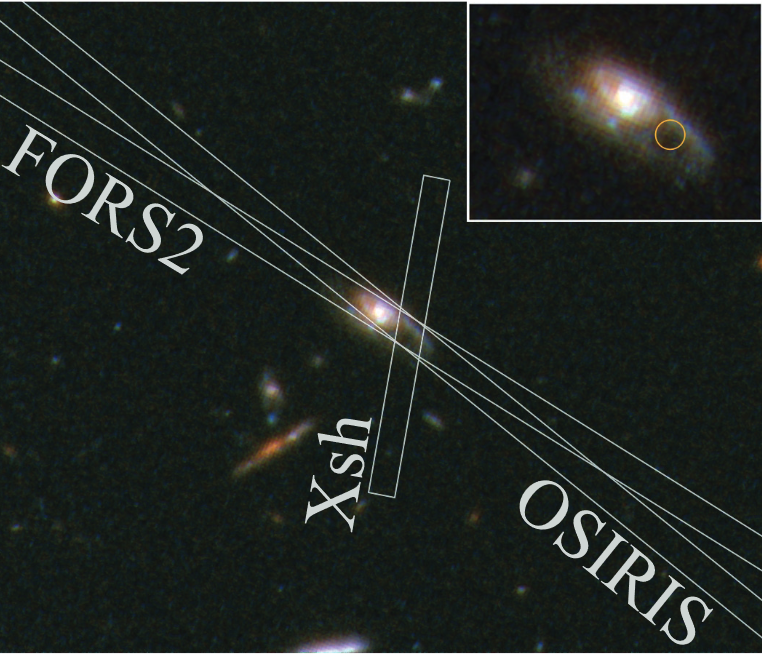
Laskar 2013 高红移暴GRB 120521C的观测

主要内容:
photometric 红移是6.

精彩摘抄:


文章信息:
· Find Similar Abstracts (with default settings below)
· Electronic Refereed Journal Article (HTML)
· Full Refereed Journal Article (PDF/Postscript)
· arXiv e-print (arXiv:1307.6586)
· References in the article
· Citations to the Article (2) (Citation History)
· Refereed Citations to the Article
· Also-Read Articles (Reads History)
·
· Translate This Page
Title:
GRB 120521C at z ~ 6 and the Properties of High-redshift γ-Ray Bursts
Authors:
Laskar, Tanmoy; Berger, Edo; Tanvir, Nial; Zauderer, B. Ashley; Margutti, Raffaella; Levan, Andrew; Perley, Daniel; Fong, Wen-fai; Wiersema, Klaas; Menten, Karl; Hrudkova, Marie
Affiliation:
AA(Harvard-Smithsonian Center for Astrophysics, 60 Garden Street, Cambridge, MA 02138, USA), AB(Harvard-Smithsonian Center for Astrophysics, 60 Garden Street, Cambridge, MA 02138, USA), AC(Department of Physics and Astronomy, University of Leicester, University Road, Leicester LE1 7RH, UK), AD(Harvard-Smithsonian Center for Astrophysics, 60 Garden Street, Cambridge, MA 02138, USA), AE(Harvard-Smithsonian Center for Astrophysics, 60 Garden Street, Cambridge, MA 02138, USA), AF(Department of Physics, University of Warwick, Coventry CV4 7AL, UK), AG(Department of Astronomy, California Institute of Technology, MC 249-17, 1200 East California Boulevard, Pasadena, CA 91125, USA), AH(Harvard-Smithsonian Center for Astrophysics, 60 Garden Street, Cambridge, MA 02138, USA), AI(Department of Physics and Astronomy, University of Leicester, University Road, Leicester LE1 7RH, UK), AJ(Max-Planck-Institut für Radioastronomie, Auf dem Hügel 69, D-53121 Bonn, Germany), AK(Isaac Newton Group of Telescopes, Apartado de Correos 321, E-387 00 Santa Cruz de la Palma, Canary Islands, Spain)
Publication:
The Astrophysical Journal, Volume 781, Issue 1, article id. 1, 24 pp. (2014). (ApJ Homepage)
Publication Date:
01/2014
Origin:
IOP
Astronomy Keywords:
gamma-ray burst: general, gamma-ray burst: individual: GRB 120521C GRB 050904 GRB 090423
DOI:
10.1088/0004-637X/781/1/1
Bibliographic Code:
2014ApJ...781....1L

Abstract

We present optical, near-infrared, and radio observations of the afterglow of GRB 120521C. By modeling the multi-wavelength data set, we derive a photometric redshift of z ≈ 6.0, which we confirm with a low signal-to-noise ratio spectrum of the afterglow. We find that a model with a constant-density environment provides a good fit to the afterglow data, with an inferred density of n <~ 0.05 cm–3. The radio observations reveal the presence of a jet break at t jet ≈ 7 d, corresponding to a jet opening angle of θjet ≈ 3°. The beaming-corrected γ-ray and kinetic energies are E γ ≈ EK ≈ 3 × 1050 erg. We quantify the uncertainties in our results using a detailed Markov Chain Monte Carlo analysis, which allows us to uncover degeneracies between the physical parameters of the explosion. To compare GRB 120521C to other high-redshift bursts in a uniform manner we re-fit all available afterglow data for the two other bursts at z >~ 6 with radio detections (GRBs 050904 and 090423). We find a jet break at t jet ≈ 15 d for GRB 090423, in contrast to previous work. Based on these three events, we find that γ-ray bursts (GRBs) at z >~ 6 appear to explode in constant-density environments, and exhibit a wide range of energies and densities that span the range inferred for lower redshift bursts. On the other hand, we find a hint for narrower jets in the z >~ 6 bursts, potentially indicating a larger true event rate at these redshifts. Overall, our results indicate that long GRBs share a common progenitor population at least to z ~ 8.

Bibtex entry for this abstract   Preferred format for this abstract (see Preferences)

星期六, 二月 08, 2014

Schulze 2014 GRB 120422A/SN 2012bz 的观测

主要内容:
它是一个光度不高不低的伽马暴(很多和超新星成协的伽马暴要么是光度很低的,比如980425,031203等,要么是光度很高的,比如080319B等)。
超级详细的一个观测文章。

精彩摘抄:


文章信息:
· Find Similar Abstracts (with default settings below)
· arXiv e-print (arXiv:1401.3774)
· References in the Article
· Also-Read Articles (Reads History)
·
· Translate This Page
Title:
GRB 120422A/SN 2012bz: Bridging the Gap between Low- And High-Luminosity GRBs
Authors:
Schulze, S.; Malesani, D.; Cucchiara, A.; Tanvir, N. R.; Krühler, T.; de Ugarte Postigo, A.; Leloudas, G.; Lyman, J.; Bersier, D.; Wiersema, K.; Perley, D. A.; Schady, P.; Gorosabel, J.; Anderson, J. P.; Castro-Tirado, A. J.; Cenko, S. B.; De Cia, A.; Ellerbroek, L. E.; Fynbo, J. P. U.; Greiner, J.; Hjorth, J.; Kann, D. A.; Kaper, L.; Klose, S.; Levan, A. J.; Martín, S.; O'Brien, P. T.; Page, K. L.; Pignata, G.; Rapaport, S.; Sánchez-Ramírez, R.; Sollerman, J.; Smith, I. A.; Sparre, M.; Thöne, C. C.; Watson, D. J.; Xu, D.; Bauer, F. E.; Bayliss, M.; Björnsson, G.; Bremer, M.; Cano, Z.; Covino, S.; D'Elia, V.; Frail, D. A.; Geier, S.; Goldoni, P.; Hartoog, O. E.; Jakobsson, P.; Korhonen, H.; Lee, K. Y.; Milvang-Jensen, B.; Nardini, M.; Nicuesa Guelbenzu, A.; Oguri, M.; Pandey, S. B.; Petitpas, G.; Rossi, A.; Sandberg, A.; Schmidl, S.; Tagliaferri, G.; Tilanus, R. P. J.; Winters, J. M.; Wright, D.; Wuyts, E.
Publication:
eprint arXiv:1401.3774
Publication Date:
01/2014
Origin:
ARXIV
Keywords:
Astrophysics - High Energy Astrophysical Phenomena, Astrophysics - Cosmology and Extragalactic Astrophysics
Comment:
30 pages, 17 figures, 9 tables; abstract is abridged; images are shown at reduced resolution; comments are welcome
Bibliographic Code:
2014arXiv1401.3774S

Abstract

At low redshift, a handful of gamma-ray bursts (GRBs) have been discovered with peak luminosities ($L_{\rm iso} < 10^{48.5}~\rm{erg\,s}^{-1}$) substantially lower than the average of the more distant ones ($L_{\rm iso} > 10^{49.5}~\rm{erg\,s}^{-1}$). The properties of several low-luminosity (low-$L$) GRBs indicate that they can be due to shock break-out, as opposed to the emission from ultrarelativistic jets. Owing to this, it is highly debated how both populations are connected, and whether there is a continuum between them. The burst at redshift $z=0.283$ from 2012 April 22 is one of the very few examples of intermediate-$L$ GRBs with a $\gamma$-ray luminosity of $L\sim10^{48.9}~\rm{erg\,s}^{-1}$ that have been detected up to now. Together with the robust detection of its accompanying supernova SN 2012bz, it has the potential to answer important questions on the origin of low- and high-$L$ GRBs and the GRB-SN connection. We carried out a spectroscopy campaign using medium- and low-resolution spectrographs at 6--10-m class telescopes, covering the time span of 37.3 days, and a multi-wavelength imaging campaign from radio to X-ray energies over a duration of $\sim270$ days. Furthermore, we used a tuneable filter centred at H$\alpha$ to map star formation in the host galaxy and the surrounding galaxies. We used these data to extract and model the properties of different radiation components and incorporate spectral-energy-distribution fitting techniques to extract the properties of the host galaxy. Modelling the light curve and spectral energy distribution from the radio to the X-rays revealed the blast-wave to expand with an initial Lorentz factor of $\Gamma_0\sim60$, low for a high-$L$ GRB, and that the afterglow had an exceptional low peak luminosity-density of $\lesssim2\times10^{30}~\rm{erg\,s}^{-1}\,\rm{Hz}^{-1}$ in the sub-mm. [Abridged]

Bibtex entry for this abstract   Preferred format for this abstract (see Preferences)

de Ugarte Postigo, A. 2013 GRB 130603B的宿主星系和环境及全方位观测

主要内容:
发现它还是在恒星形成区的,说明要么kick速度比较小,要么轨道比较短很快就并合了。

精彩摘抄:


文章信息:
· Find Similar Abstracts (with default settings below)
· arXiv e-print (arXiv:1308.2984)
· References in the Article
· Citations to the Article (6) (Citation History)
· Refereed Citations to the Article
· Also-Read Articles (Reads History)
·
· Translate This Page
Title:
Spectroscopy of the short-hard GRB 130603B: The host galaxy and environment of a compact object merger
Authors:
de Ugarte Postigo, A.; Thoene, C. C.; Rowlinson, A.; Garcia-Benito, R.; Levan, A. J.; Gorosabel, J.; Goldoni, P.; Schulze, S.; Zafar, T.; Wiersema, K.; Sanchez-Ramirez, R.; Melandri, A.; D'Avanzo, P.; Oates, S.; D'Elia, V.; De Pasquale, M.; Kruehler, T.; van der Horst, A. J.; Xu, D.; Watson, D.; Piranomonte, S.; Vergani, S.; Milvang-Jensen, B.; Kaper, L.; Malesani, D.; Fynbo, J. P. U.; Cano, Z.; Covino, S.; Flores, H.; Greiss, S.; Hammer, F.; Hartoog, O. E.; Hellmich, S.; Heuser, C.; Hjorth, J.; Jakobsson, P.; Mottola, S.; Sparre, M.; Sollerman, J.; Tagliaferri, G.; Tanvir, N. R.; Vestergaard, M.; Wijers, R. A. M. J.
Publication:
eprint arXiv:1308.2984
Publication Date:
08/2013
Origin:
ARXIV
Keywords:
Astrophysics - Cosmology and Extragalactic Astrophysics, Astrophysics - High Energy Astrophysical Phenomena
Comment:
Accepted for publication in Astronomy and Astrophysics
Bibliographic Code:
2013arXiv1308.2984D

Abstract

Short duration gamma-ray bursts (SGRBs) are thought to be related to the violent merger of compact objects, such as neutron stars or black holes, which makes them promising sources of gravitational waves. The detection of a 'kilonova'-like signature associated to the Swift-detected GRB 130603B has suggested that this event is the result of a compact object merger. Our knowledge on SGRB has been, until now, mostly based on the absence of supernova signatures and the analysis of the host galaxies to which they cannot always be securely associated. Further progress has been significantly hampered by the faintness and rapid fading of their optical counterparts (afterglows), which has so far precluded spectroscopy of such events. Afterglow spectroscopy is the key tool to firmly determine the distance at which the burst was produced, crucial to understand its physics, and study its local environment. Here we present the first spectra of a prototypical SGRB afterglow in which both absorption and emission features are clearly detected. Together with multiwavelength photometry we study the host and environment of GRB 130603B. From these spectra we determine the redshift of the burst to be z = 0.3565+/-0.0002, measure rich dynamics both in absorption and emission, and a substantial line of sight extinction of A_V = 0.86+/-0.15 mag. The GRB was located at the edge of a disrupted arm of a moderately star forming galaxy with near-solar metallicity. Unlike for most long GRBs (LGRBs), N_HX / A_V is consistent with the Galactic ratio, indicating that the explosion site differs from those found in LGRBs. The merger is not associated with the most star-forming region of the galaxy; however, it did occur in a dense region, implying a rapid merger or a low natal kick velocity for the compact object binary.

Bibtex entry for this abstract   Preferred format for this abstract (see Preferences)

星期五, 二月 07, 2014

Fong, W. 2013 GRB 130603B的各波段余辉

主要内容:


精彩摘抄:


文章信息:

· Find Similar Abstracts (with default settings below)
· Electronic Refereed Journal Article (HTML)
· Full Refereed Journal Article (PDF/Postscript)
· arXiv e-print (arXiv:1309.7479)
· References in the article
· Citations to the Article (7) (Citation History)
· Refereed Citations to the Article
· SIMBAD Objects (17)
· Also-Read Articles (Reads History)
·
· Translate This Page
Title:
Short GRB 130603B: Discovery of a Jet Break in the Optical and Radio Afterglows, and a Mysterious Late-time X-Ray Excess
Authors:
Fong, W.; Berger, E.; Metzger, B. D.; Margutti, R.; Chornock, R.; Migliori, G.; Foley, R. J.; Zauderer, B. A.; Lunnan, R.; Laskar, T.; Desch, S. J.; Meech, K. J.; Sonnett, S.; Dickey, C.; Hedlund, A.; Harding, P.
Affiliation:
AA(Harvard-Smithsonian Center for Astrophysics, 60 Garden Street, Cambridge, MA 02138, USA), AB(Harvard-Smithsonian Center for Astrophysics, 60 Garden Street, Cambridge, MA 02138, USA), AC(Department of Physics and Columbia Astrophysics Laboratory, Columbia University, New York, NY 10027, USA), AD(Harvard-Smithsonian Center for Astrophysics, 60 Garden Street, Cambridge, MA 02138, USA), AE(Harvard-Smithsonian Center for Astrophysics, 60 Garden Street, Cambridge, MA 02138, USA), AF(Harvard-Smithsonian Center for Astrophysics, 60 Garden Street, Cambridge, MA 02138, USA), AG(Astronomy Department, University of Illinois at Urbana-Champaign, 1002 W. Green Street, Urbana, IL 61801, USA ; Department of Physics, University of Illinois Urbana-Champaign, 1110 W. Green Street, Urbana, IL 61801, USA), AH(Harvard-Smithsonian Center for Astrophysics, 60 Garden Street, Cambridge, MA 02138, USA), AI(Harvard-Smithsonian Center for Astrophysics, 60 Garden Street, Cambridge, MA 02138, USA), AJ(Harvard-Smithsonian Center for Astrophysics, 60 Garden Street, Cambridge, MA 02138, USA), AK(School of Earth and Space Exploration, Arizona State University, P.O. Box 871404, Tempe, AZ 85287-1404, USA), AL(Institute for Astronomy, University of Hawaii, 2680 Woodlawn Drive, Honolulu, HI 96822, USA), AM(Institute for Astronomy, University of Hawaii, 2680 Woodlawn Drive, Honolulu, HI 96822, USA), AN(Pomona College, 610 N. College Ave., Claremont, CA 91711, USA), AO(Pomona College, 610 N. College Ave., Claremont, CA 91711, USA), AP(Department of Astronomy, Case Western Reserve University, Cleveland, OH 44106-7215, USA)
Publication:
The Astrophysical Journal, Volume 780, Issue 2, article id. 118, 9 pp. (2014). (ApJ Homepage)
Publication Date:
01/2014
Origin:
IOP
Astronomy Keywords:
gamma-ray burst: individual: 130603B
DOI:
10.1088/0004-637X/780/2/118
Bibliographic Code:
2014ApJ...780..118F

Abstract

We present radio, optical/NIR, and X-ray observations of the afterglow of the short-duration Swift and Konus-Wind GRB 130603B, and uncover a break in the radio and optical bands at ≈0.5 day after the burst, best explained as a jet break with an inferred jet opening angle of ≈4°-8°. GRB 130603B is only the third short GRB with a radio afterglow detection to date, and represents the first time that a jet break has been evident in the radio band. We model the temporal evolution of the spectral energy distribution to determine the burst explosion properties and find an isotropic-equivalent kinetic energy of ≈(0.6-1.7) × 1051 erg and a circumburst density of ≈5 × 10⁻³-30 cm–3. From the inferred opening angle of GRB 130603B, we calculate beaming-corrected energies of E γ ≈ (0.5-2) × 1049 erg and E K ≈ (0.1-1.6) × 1049 erg. Along with previous measurements and lower limits we find a median opening angle of ≈10°. Using the all-sky observed rate of 10 Gpc–3 yr–1, this implies a true short GRB rate of ≈20 yr–1 within 200 Mpc, the Advanced LIGO/VIRGO sensitivity range for neutron star binary mergers. Finally, we uncover evidence for significant excess emission in the X-ray afterglow of GRB 130603B at >~ 1 day and conclude that the additional energy component could be due to fall-back accretion or spin-down energy from a magnetar formed following the merger.

Bibtex entry for this abstract   Preferred format for this abstract (see Preferences)

Kouveliotou 2013 NuSTAR对GRB 130427A 3 – 79 keV 的余辉观测

主要内容:


精彩摘抄:


文章信息:

· Find Similar Abstracts (with default settings below)
· Electronic Refereed Journal Article (HTML)
· Full Refereed Journal Article (PDF/Postscript)
· arXiv e-print (arXiv:1311.5245)
· On-line Data
· References in the article
· Citations to the Article (1) (Citation History)
· Refereed Citations to the Article
· SIMBAD Objects (3)
· Also-Read Articles (Reads History)
·
· Translate This Page
Title:
NuSTAR Observations of GRB 130427A Establish a Single Component Synchrotron Afterglow Origin for the Late Optical to Multi-GeV Emission
Authors:
Kouveliotou, C.; Granot, J.; Racusin, J. L.; Bellm, E.; Vianello, G.; Oates, S.; Fryer, C. L.; Boggs, S. E.; Christensen, F. E.; Craig, W. W.; Dermer, C. D.; Gehrels, N.; Hailey, C. J.; Harrison, F. A.; Melandri, A.; McEnery, J. E.; Mundell, C. G.; Stern, D. K.; Tagliaferri, G.; Zhang, W. W.
Affiliation:
AA(Astrophysics Office/ZP12, NASA Marshall Space Flight Center, Huntsville, AL 35812, USA chryssa.kouveliotou@nasa.gov), AB(Department of Natural Sciences, The Open University of Israel, 1 University Road, P.O. Box 808, Ra'anana 43537, Israel granot@openu.ac.il), AC(NASA Goddard Space Flight Center, Greenbelt, MD 20771, USA judith.racusin@nasa.gov), AD(Cahill Center for Astronomy and Astrophysics, California Institute of Technology, 1200 E. California Blvd., Pasadena, CA 91125, USA), AE(W. Hansen Experimental Physics Laboratory, Kavli Institute for Particle Astrophysics and Cosmology, Department of Physics and SLAC National Accelerator Laboratory, Stanford University, Stanford, CA 94305, USA), AF(Mullard Space Science Laboratory, University College London, Holmbury St. Mary, Dorking, Surrey RH5 6NT, UK), AG(CCS-2, Los Alamos National Laboratory, Los Alamos, NM 87545, USA), AH(Space Sciences Laboratory, University of California, Berkeley, CA 94720, USA), AI(DTU Space-National Space Institute, Technical University of Denmark, Elektrovej 327, 2800 Lyngby, Denmark), AJ(Space Sciences Laboratory, University of California, Berkeley, CA 94720, USA; Lawrence Livermore National Laboratory, Livermore, CA 94550, USA), AK(Code 7653, National Research Laboratory, Washington, DC 20375-5352, USA), AL(NASA Goddard Space Flight Center, Greenbelt, MD 20771, USA), AM(Columbia Astrophysics Laboratory, Columbia University, New York, NY 10027, USA), AN(Cahill Center for Astronomy and Astrophysics, California Institute of Technology, 1200 E. California Blvd., Pasadena, CA 91125, USA), AO(INAF-Osservatorio Astronomico di Brera, via E. Bianchi 46, I-23807 Merate, Italy), AP(NASA Goddard Space Flight Center, Greenbelt, MD 20771, USA), AQ(Astrophysics Research Institute, Liverpool John Moores University, 146 Brownlow Hill, Liverpool Science Park, Liverpool L3 5RF, UK), AR(Jet Propulsion Laboratory, California Institute of Technology, Pasadena, CA 91109, USA), AS(INAF-Osservatorio Astronomico di Brera, via E. Bianchi 46, I-23807 Merate, Italy), AT(NASA Goddard Space Flight Center, Greenbelt, MD 20771, USA)
Publication:
The Astrophysical Journal Letters, Volume 779, Issue 1, article id. L1, 6 pp. (2013). (ApJL Homepage)
Publication Date:
12/2013
Origin:
IOP
Astronomy Keywords:
acceleration of particles, gamma-ray burst: individual: GRB 130427A, magnetic fields, radiation mechanisms: non-thermal, shock waves
DOI:
10.1088/2041-8205/779/1/L1
Bibliographic Code:
2013ApJ...779L...1K

Abstract

GRB 130427A occurred in a relatively nearby galaxy; its prompt emission had the largest GRB fluence ever recorded. The afterglow of GRB 130427A was bright enough for the Nuclear Spectroscopic Telescope ARray (NuSTAR) to observe it in the 3-79 keV energy range long after its prompt emission (~1.5 and 5 days). This range, where afterglow observations were previously not possible, bridges an important spectral gap. Combined with Swift, Fermi, and ground-based optical data, NuSTAR observations unambiguously establish a single afterglow spectral component from optical to multi-GeV energies a day after the event, which is almost certainly synchrotron radiation. Such an origin of the late-time Fermi/Large Area Telescope >10 GeV photons requires revisions in our understanding of collisionless relativistic shock physics.

Bibtex entry for this abstract   Preferred format for this abstract (see Preferences)

Maselli 2013 GRB 130427A的Swift、光学等多波段观测

主要内容:


精彩摘抄:

GRB 130427A with Swift, the 2-m Liverpool and Faulkes telescopes and by other ground-based facilities, highlighting the evolution of the burst emission from the prompt to the afterglow phase. 
对数坐标:

和另一个超亮暴比较


文章信息:
· Find Similar Abstracts (with default settings below)
· arXiv e-print (arXiv:1311.5254)
· References in the Article
· Citations to the Article (3) (Citation History)
· Refereed Citations to the Article
· Also-Read Articles (Reads History)
·
· Translate This Page
Title:
GRB 130427A: a Nearby Ordinary Monster
Authors:
Maselli, A.; Melandri, A.; Nava, L.; Mundell, C. G.; Kawai, N.; Campana, S.; Covino, S.; Cummings, J. R.; Cusumano, G.; Evans, P. A.; Ghirlanda, G.; Ghisellini, G.; Guidorzi, C.; Kobayashi, S.; Kuin, P.; La Parola, V.; Mangano, V.; Oates, S.; Sakamoto, T.; Serino, M.; Virgili, F.; Zhang, B.-B.; Barthelmy, S.; Beardmore, A.; Bernardini, M. G.; Bersier, D.; Burrows, D.; Calderone, G.; Capalbi, M.; Chiang, J.; D'Avanzo, P.; D'Elia, V.; De Pasquale, M.; Fugazza, D.; Gehrels, N.; Gomboc, A.; Harrison, R.; Hanayama, H.; Japelj, J.; Kennea, J.; Kopac, D.; Kouveliotou, C.; Kuroda, D.; Levan, A.; Malesani, D.; Marshall, F.; Nousek, J.; O'Brien, P.; Osborne, J. P.; Pagani, C.; Page, K. L.; Page, M.; Perri, M.; Pritchard, T.; Romano, P.; Saito, Y.; Sbarufatti, B.; Salvaterra, R.; Steele, I.; Tanvir, N.; Vianello, G.; Wiegand, B.; Wiersema, K.; Yatsu, Y.; Yoshii, T.; Tagliaferri, G.
Publication:
eprint arXiv:1311.5254
Publication Date:
11/2013
Origin:
ARXIV
Keywords:
Astrophysics - High Energy Astrophysical Phenomena
Comment:
64 pages, 11 figures; published in Science. Update for a few references and correction of a typo in the name of one of the authors; Science 343 (2014) 48-51; doi:10.1126/science.1242279
Bibliographic Code:
2013arXiv1311.5254M

Abstract

Long-duration Gamma-Ray Bursts (GRBs) are an extremely rare outcome of the collapse of massive stars, and are typically found in the distant Universe. Because of its intrinsic luminosity ($L\sim 3 \times 10^{53}$ erg s$^{-1}$) and its relative proximity ($z=0.34$), GRB 130427A was a unique event that reached the highest fluence observed in the gamma-ray band. Here we present a comprehensive multiwavelength view of GRB 130427A with Swift, the 2-m Liverpool and Faulkes telescopes and by other ground-based facilities, highlighting the evolution of the burst emission from the prompt to the afterglow phase. The properties of GRB 130427A are similar to those of the most luminous, high-redshift GRBs, suggesting that a common central engine is responsible for producing GRBs in both the contemporary and the early Universe and over the full range of GRB isotropic energies.

Bibtex entry for this abstract   Preferred format for this abstract (see Preferences)