伽玛暴(Gamma-Ray Burst)笔记。记录有关伽玛暴的新文章,另外也包括看的老文章、自己的想法、以及跟天文相关的一些东西。 Feel free to leave me a message by comments or by email.

显示标签为“1.d progenitor”的博文。显示所有博文

星期六, 二月 08, 2014

Smidt 2014 Pop III Hypernovae

主要内容:
大质量的超亮的Ib/c型超新星。文章是simulation。

精彩摘抄:


文章信息:

· Find Similar Abstracts (with default settings below)
· arXiv e-print (arXiv:1401.5837)
· References in the Article
· Also-Read Articles (Reads History)
·
· Translate This Page
Title:
Population III Hypernovae
Authors:
Smidt, Joseph; Whalen, Daniel J.; Even, Wesley; Wiggins, Brandon; Johnson, Jarrett L.; Fryer, Chris L.
Publication:
eprint arXiv:1401.5837
Publication Date:
01/2014
Origin:
ARXIV
Keywords:
Astrophysics - Cosmology and Extragalactic Astrophysics
Comment:
15 pages, 11 figures, submitted to ApJ
Bibliographic Code:
2014arXiv1401.5837S

Abstract

Population III supernovae have been of growing interest of late for their potential to directly probe the properties of the first stars, particularly the most energetic events that are visible near the edge of the observable universe. But until now, hypernovae, the unusually energetic Type Ib/c supernovae that are sometimes associated with gamma-ray bursts, have been overlooked as cosmic lighthouses at the highest redshifts. In this, the latest of a series of studies on Population III supernovae, we present numerical simulations of 25 - 50 M$_{\odot}$ hypernovae and their light curves done with the Los Alamos RAGE and SPECTRUM codes. We find that they will be visible at z = 10 - 15 to the James Webb Space Telescope (JWST) and z = 4 - 5 to the Wide-Field Infrared Survey Telescope (WFIRST), tracing star formation rates in the first galaxies and at the end of cosmological reionization. If, however, the hypernova crashes into a dense shell ejected by its progenitor, a superluminous event will occur that may be seen at z ~ 20, in the first generation of stars.

Bibtex entry for this abstract   Preferred format for this abstract (see Preferences)

星期五, 二月 07, 2014

Hao, Jing-Meng 2013 短暴的delay time

主要内容:
通过对delay time的分布来限制短暴的前身星。

精彩摘抄:


文章信息:


· Find Similar Abstracts (with default settings below)
· Electronic Refereed Journal Article (HTML)
· Full Refereed Journal Article (PDF/Postscript)
· arXiv e-print (arXiv:1309.7521)
· References in the article
· Citations to the Article (1) (Citation History)
· Refereed Citations to the Article
· SIMBAD Objects (27)
· Also-Read Articles (Reads History)
·
· Translate This Page
Title:
Progenitor delay-time distribution of short gamma-ray bursts: Constraints from observations
Authors:
Hao, Jing-Meng; Yuan, Ye-Fei
Affiliation:
AA(Key Laboratory for Research in Galaxies and Cosmology CAS, Department of Astronomy, University of Science and Technology of China Hefei, Anhui, 230026, PR China yfyuan@ustc.edu.cn), AB(Key Laboratory for Research in Galaxies and Cosmology CAS, Department of Astronomy, University of Science and Technology of China Hefei, Anhui, 230026, PR China)
Publication:
Astronomy & Astrophysics, Volume 558, id.A22, 6 pp. (A&A Homepage)
Publication Date:
10/2013
Origin:
EDP Sciences
Astronomy Keywords:
gamma-ray burst: general, binaries: close, stars: evolution, stars: formation, stars: neutron, black hole physics
DOI:
10.1051/0004-6361/201321471
Bibliographic Code:
2013A&A...558A..22H

Abstract

Context. The progenitors of short gamma-ray bursts (SGRBs) have not yet been well identified. The most popular model is the merger of compact object binaries (NS-NS/NS-BH). However, other progenitor models cannot be ruled out. The delay-time distribution of SGRB progenitors, which is an important property to constrain progenitor models, is still poorly understood.
Aims: We aim to better constrain the luminosity function of SGRBs and the delay-time distribution of their progenitors with newly discovered SGRBs.
Methods: We present a low-contamination sample of 16 Swift SGRBs that is better defined by a duration shorter than 0.8 s. By using this robust sample and by combining a self-consistent star formation model with various models for the distribution of time delays, the redshift distribution of SGRBs is calculated and then compared to the observational data.
Results: We find that the power-law delay distribution model is disfavored and that only the lognormal delay distribution model with the typical delay τ ≳ 3 Gyr is consistent with the data. Comparing Swift SGRBs with T90 > 0.8 s to our robust sample (T90 < 0.8 s), we find a significant difference in the time delays between these two samples.
Conclusions: Our results show that the progenitors of SGRBs are dominated by relatively long-lived systems (τ ≳ 3 Gyr), which contrasts the results found for Type Ia supernovae. We therefore conclude that primordial NS-NS systems are not favored as the dominant SGRB progenitors. Alternatively, dynamically formed NS-NS/BH and primordial NS-BH systems with average delays longer than 5 Gyr may contribute a significant fraction to the overall SGRB progenitors.

Bibtex entry for this abstract   Preferred format for this abstract (see Preferences)

星期日, 二月 05, 2012

Woosley, S. E. 2011 长伽马暴的可能坍缩星模型

主要内容:
以超长暴 110328A-Sw 1644+57为出发点,看有哪些可以产生这么长暴的坍缩星模型:blue supergiants with low mass loss rates, tidally-interacting binaries involving either helium stars or giant stars, and the collapse to a black hole of very massive pair-instability supernovae.

精彩摘抄:


文章信息:


· Find Similar Abstracts (with default settings below)
· arXiv e-print (arXiv:1110.3842)
· References in the Article
· Citations to the Article (1) (Citation History)
· Refereed Citations to the Article
· Also-Read Articles (Reads History)
·
· Translate This Page
Title:
Long Gamma-Ray Transients from Collapsars
Authors:
Woosley, S. E.; heger, Alexander
Publication:
eprint arXiv:1110.3842
Publication Date:
10/2011
Origin:
ARXIV
Keywords:
Astrophysics - High Energy Astrophysical Phenomena
Comment:
submitted to Astrophysical Journal
Bibliographic Code:
2011arXiv1110.3842W

Abstract

In the collapsar model for common gamma-ray bursts, the formation of a centrifugally supported disk occurs during the first $\sim$10 seconds following the collapse of the iron core in a massive star. This only occurs in a small fraction of massive stellar deaths, however, and requires unusual conditions. A much more frequent occurrence could be the death of a star that makes a black hole and a weak or absent outgoing shock, but in a progenitor that only has enough angular momentum in its outermost layers to make a disk. We consider several cases where this is likely to occur - blue supergiants with low mass loss rates, tidally-interacting binaries involving either helium stars or giant stars, and the collapse to a black hole of very massive pair-instability supernovae. These events have in common the accretion of a solar mass or so of material through a disk over a period much longer than the duration of a common gamma-ray burst. A broad range of powers is possible, $10^{47}$ to $10^{50}\,$erg s$^{-1}$, and this brightness could be enhanced by beaming. Such events were probably more frequent in the early universe where mass loss rates were lower. Indeed this could be one of the most common forms of gamma-ray transients in the universe and could be used to study first generation stars. Several events could be active in the sky at any one time. A recent example of this sort of event may have been the SWIFT transient Sw-1644+57.
Bibtex entry for this abstract   Preferred format for this abstract (see Preferences)

Lazzati, Davide 2011 用中心引擎的持续时间来分类伽马暴Ibc型超新星等

主要内容:
假设中心引擎的持续时间就是能产生喷流的时间,考虑到喷流还要穿过恒星包层,那么喷流时间最长的能产生正常的长伽马暴;中等长度的只能产生如GRB 980425样的弱伽马暴;短的只产生超新星,不过这种超新星的速度蛮快的;最短的,就只有一个一般的超新星,而没有任何伽马暴的特征了。

精彩摘抄:


文章信息:
· Find Similar Abstracts (with default settings below)
· arXiv e-print (arXiv:1111.0970)
· References in the Article
· Citations to the Article (1) (Citation History)
· Refereed Citations to the Article
· Also-Read Articles (Reads History)
·
· Translate This Page
Title:
Unifying the Zoo of Jet-Driven Stellar Explosions
Authors:
Lazzati, Davide; Morsony, Brian J.; Blackwell, Christopher H.; Begelman, Micthell C.
Publication:
eprint arXiv:1111.0970
Publication Date:
11/2011
Origin:
ARXIV
Keywords:
Astrophysics - High Energy Astrophysical Phenomena, Astrophysics - Cosmology and Extragalactic Astrophysics, Astrophysics - Solar and Stellar Astrophysics
Comment:
8 pages, 5 figures, submitted to ApJL. Full resolution version of Fig. 1 available at http://grb.physics.ncsu.edu/ms_hr.pdf
Bibliographic Code:
2011arXiv1111.0970L

Abstract

We present a set of numerical simulations of stellar explosions induced by relativistic jets emanating from a central engine sitting at the center of compact, dying stars. We explore a wide range of durations of the central engine activity, two candidate stellar progenitors, and two possible values of the total energy release. We find that even if the jets are narrowly collimated, their interaction with the star unbinds the stellar material, producing a stellar explosion. We also find that the outcome of the explosion can be very different depending on the duration of the engine activity. Only the longest-lasting engines result in successful gamma-ray bursts. Engines that power jets only for a short time result in relativistic supernova explosions, akin to observed engine-driven SNe such as SN2009bb. Engines with intermediate durations produce weak gamma-ray bursts, with properties similar to nearby bursts such as GRB 980425. Finally, we find that the engines with the shortest durations, if they exist in nature, produce stellar explosions that lack sizable amounts of relativistic ejecta and are therefore dynamically indistinguishable from ordinary core-collapse supernovae.

Bibtex entry for this abstract   Preferred format for this abstract (see Preferences)

Le Floc'h, E. 2011 GRB980425暴周环境的红外观测

主要内容:
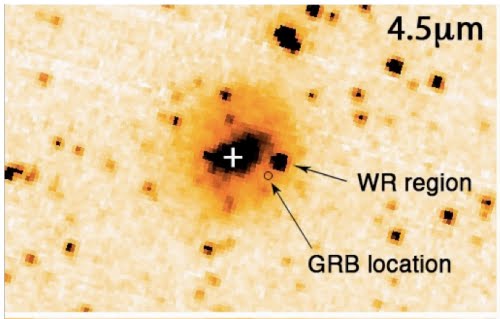
用Spitzer看的,发现宿主星系有一个WR区。

精彩摘抄:


文章信息:
· Find Similar Abstracts (with default settings below)
· arXiv e-print (arXiv:1111.1234)
· References in the Article
· Citations to the Article (1) (Citation History)
· Refereed Citations to the Article
· Also-Read Articles (Reads History)
·
· Translate This Page
Title:
The first Infrared study of the close environment of a long Gamma-Ray Burst
Authors:
Le Floc'h, E.; Charmandaris, V.; Gordon, K.; Forrest, W. J.; Brandl, B.; Schaerer, D.; Dessauges-Zavadsky, M.; Armus, L.
Publication:
eprint arXiv:1111.1234
Publication Date:
11/2011
Origin:
ARXIV
Keywords:
Astrophysics - Cosmology and Extragalactic Astrophysics, Astrophysics - High Energy Astrophysical Phenomena
Comment:
ApJ in press, 14 pages, 2 tables, 7 figures
Bibliographic Code:
2011arXiv1111.1234L

Abstract

We present a characterization of the close environment of GRB980425 based on 5-160mic spectro-imaging obtained with Spitzer. The Gamma-Ray Burst GRB980425 occurred in a nearby (z=0.0085) SBc-type dwarf galaxy, at a projected distance of 900pc from an HII region with strong signatures of Wolf-Rayet (WR) stars. While this "WR region" produces less than 5% of the B-band emission of the host, we find that it is responsible for 45+/-10% of the total infrared luminosity, with a maximum contribution reaching 75% at 25-30mic. This atypical property is rarely observed among morphologically-relaxed dwarves, suggesting a strong causal link with the GRB event. The luminosity of the WR region (L_8-1000mic=4.6x10^8 Lsol), the peak of its spectral energy distribution at <~100mic and the presence of highly-ionized emission lines (e.g., [NeIII]) also reveal extremely young (<5Myr) star-forming activity, with a typical time-scale of only 47Myr to double the stellar mass already built. Finally, the mid-IR over B-band luminosity ratio in this region is substantially higher than in star-forming galaxies with similar L_IR, but it is lower than in young dust-enshrouded stellar clusters. Considering the modest obscuration measured from the silicate features (tau_9.7mic ~ 0.015), this suggests that the WR region is dominated by one or several star clusters that have either partly escaped or cleared out their parent molecular cloud. Combined with the properties characterizing the whole population of GRB hosts, our results reinforce the idea that long GRBs mostly happen within or in the vicinity of relatively unobscured galactic regions harboring very recent star formation.
Bibtex entry for this abstract   Preferred format for this abstract (see Preferences)

星期六, 二月 04, 2012

Bromberg, Omer 2011 伽马暴坍缩星模型的一个证据

主要内容:
下图的平台是证据。考虑到喷流冲出包层需要时间,只有冲出后的时间才被当做T90.这就相当于X射线shellow decay的时间零点移动模型一样。那么在时间短的那些暴满足的power law的分布应该是(T90+tau)^-alpha,换成T90^-beta就有一个平台。
更短的地方的突起就不应该是坍缩星的,而是另一类,短暴。


精彩摘抄:


文章信息:
· Find Similar Abstracts (with default settings below)
· arXiv e-print (arXiv:1111.2990)
· References in the Article
· Citations to the Article (2) (Citation History)
· Refereed Citations to the Article
· Also-Read Articles (Reads History)
·
· Translate This Page
Title:
An observational imprint of the Collapsar model of long Gamma Ray Bursts
Authors:
Bromberg, Omer; Nakar, Ehud; Piran, Tsvi; Sari, Re'em
Publication:
eprint arXiv:1111.2990
Publication Date:
11/2011
Origin:
ARXIV
Keywords:
Astrophysics - High Energy Astrophysical Phenomena
Comment:
12 pages, 1 figure
Bibliographic Code:
2011arXiv1111.2990B

Abstract

The Collapsar model provides a theoretical framework for the well known association between long gamma-ray bursts (GRBs) and collapsing massive stars. A bipolar relativistic jet, launched at the core of a collapsing star, drills its way through the stellar envelope and breaks out of the surface before producing the observed gamma-rays. While a wealth of observations associate GRBs with the death of massive stars, as yet there is no direct evidence for the Collapsar model itself. Here we show that a distinct signature of the Collapsar model is the appearance of a plateau in the duration distribution of the prompt GRB emission at times much shorter than the typical breakout time of the jet. This plateau is evident in the data of all three major satellites. These findings provide an evidence that directly supports the Collapsar model. Additionally, it suggests the existence of a large population of choked (failed) GRBs and that the 2 s duration commonly used to separate Collapsars and non-Collapasars is inconsistent with the duration distributions of {\it Swift} and Fermi GRBs and only holds for BATSE GRBs.
Bibtex entry for this abstract   Preferred format for this abstract (see Preferences)

Vink, J. S. 2011 某类WR星作为伽马暴的前身星

主要内容:


精彩摘抄:


文章信息:

· Find Similar Abstracts (with default settings below)
· Electronic Refereed Journal Article (HTML)
· Full Refereed Journal Article (PDF/Postscript)
· arXiv e-print (arXiv:1111.5806)
· References in the article
· SIMBAD Objects (7)
· Also-Read Articles (Reads History)
·
· Translate This Page
Title:
In pursuit of gamma-ray burst progenitors: the identification of a sub-population of rotating Wolf-Rayet stars
Authors:
Vink, J. S.; Gräfener, G.; Harries, T. J.
Affiliation:
AA(Armagh Observatory, College Hill, Armagh, BT61 9DG, Northern Ireland jsv@arm.ac.uk), AB(Armagh Observatory, College Hill, Armagh, BT61 9DG, Northern Ireland), AC(School of Physics and Astronomy, University of Exeter, Stocker Rd, Exeter, EX4 4QL, UK)
Publication:
Astronomy & Astrophysics, Volume 536, id.L10 (A&A Homepage)
Publication Date:
12/2011
Origin:
EDP Sciences
Astronomy Keywords:
stars: mass-loss, stars: winds, outflows, stars: Wolf-Rayet, stars: rotation, gamma-ray burst: general
DOI:
10.1051/0004-6361/201118197
Bibliographic Code:
2011A&A...536L..10V

Abstract

Long-duration gamma-ray bursts (GRBs) involve the most powerful cosmic explosions since the Big Bang. Whilst it has been established that GRBs are related to the death throes of massive stars, the identification of their elusive progenitors has proved challenging. Theoretical modelling suggests that rotating Wolf-Rayet (WR) stars are the best candidates. Wolf-Rayet stars are thought to be in advanced core burning stages, just prior to explosion, but their strong stellar winds shroud their surfaces, preventing a direct measurement of their rotation. Fortunately, linear spectropolarimetry may be used to probe the flattening of their winds because of stellar spin. Spectropolarimetry surveys have shown that the vast majority of WR stars (80%) have spherically symmetric winds and are therefore rotating slowly, yet a small minority (of 20%) display a spectropolarimetric signature indicative of rotation. Here we find a highly significant correlation between WR objects that carry the signature of stellar rotation and the small subset of WR stars with ejecta nebulae that have only recently transitioned from a previous red sugergiant or luminous blue variable phase. As these youthful WR stars have yet to spin-down because of mass loss, they are the best candidate GRB progenitors identified to date. When we take recently published WR ejecta nebula numbers (of Stock & Barlow 2010, MNRAS, 409, 1429), we find that five out of the six line-effect WR stars are surrounded by ejecta nebulae. The statistics imply that the null hypothesis of no correlation between line-effect WR stars and ejecta nebulae can be rejected at the 0.0004% level. Given that four line-effect and WR ejecta nebula have spectroscopically been confirmed to contain nucleo-synthetic products, we argue that the correlation is both statistically significant and physically convincing. The implication is that we have identified a sub-population of WR stars that fulfils the necessary criteria for making GRBs. Finally, we discuss the potential of identifying GRB progenitors via linear spectropolarimetry with extremely large telescopes.
Bibtex entry for this abstract   Preferred format for this abstract (see Preferences)

星期五, 二月 03, 2012

Zhang, Dong 2011 LMC Star VFTS 682可能是一个伽马暴的前身星

主要内容:
VFTS 68还是目前确认的三个WR星之一。

精彩摘抄:


文章信息:
· Find Similar Abstracts (with default settings below)
· arXiv e-print (arXiv:1112.0016)
· References in the Article
· Also-Read Articles (Reads History)
·
· Translate This Page
Title:
The Very Massive and Hot LMC Star VFTS 682: Progenitor of a Future Dark Gamma-Ray Burst?
Authors:
Zhang, Dong; Stanek, K. Z.
Publication:
eprint arXiv:1112.0016
Publication Date:
11/2011
Origin:
ARXIV
Keywords:
Astrophysics - Galaxy Astrophysics
Comment:
5 pages, 2 figures. Submitted to ApJ Letters. For a brief video explaining the key results of this paper, see this http://www.youtube.com/user/OSUAstronomy
Bibliographic Code:
2011arXiv1112.0016Z

Abstract

VFTS 682, a very massive and very hot Wolf-Rayet (WR) star recently discovered in the Large Magellanic Cloud near the famous star cluster R136, might be providing us with a glimpse of a missing link in our understanding of Long Gamma-Ray Bursts (LGRBs), including dark GRBs. It is likely its properties result from chemically homogeneous evolution (CHE), believed to be a key process for a massive star to become a GRB. It is also heavily obscured by dust extinction, which could make it a dark GRB upon explosion. Using Spitzer data we investigate the properties of interstellar dust in the vicinity of R136, and argue that its high obscuration is not unusual for its environment and that it could indeed be a slow runaway ("walkaway") from R136. Unfortunately, based on its current mass loss rate, VFTS 682 is unlikely to become a GRB, because it will lose too much angular momentum at its death. If it were to become a GRB, it probably would also not be dark, either escaping or destroying its surrounding dusty region. Nevertheless, it is a very interesting star, deserving further studies, and being one of only three presently identified WR stars (two others in the Small Magellanic Cloud) that seems to be undergoing CHE.
Bibtex entry for this abstract   Preferred format for this abstract (see Preferences)

星期五, 九月 30, 2011

Maeder 2011 旋转的大质量恒星的演化

主要内容:

就个人而言,可以通过这篇综述查看WR星的星风,知道星风的轮廓(应该不是-2).

精彩摘抄:


文章信息:

· Find Similar Abstracts (with default settings below)
· arXiv e-print (arXiv:1109.6171)
· References in the Article
·
· Translate This Page
Title:
Rotating massive stars through the ages, with applications to WR stars, Pop III stars and Gamma Ray Bursts
Authors:
Maeder, Andre; Meynet, Georges
Publication:
eprint arXiv:1109.6171
Publication Date:
09/2011
Origin:
ARXIV
Keywords:
Astrophysics - Solar and Stellar Astrophysics
Comment:
55 pages, 33 figures, 2 tables, accepted for publication in Review of Modern Physics
Bibliographic Code:
2011arXiv1109.6171M

Abstract

This article first reviews the basic physics of rotating stars and their evolution. We examine in particular the changes of the mechanical and thermal equilibrium of rotating stars. An important (predicted and observed) effect is that rotating stars are hotter at the poles and cooler at the equator. We briefly discuss the mass loss by stellar winds, which are influenced by the anisotropic temperature distribution. These anisotropies in the interior are also driving circulation currents, which transports the chemical elements and the angular momentum in stars. Internal differential rotation, if present, creates instabilities and mixing, in particular the shear mixing, the horizontal turbulence and their interactions. A major check of the model predictions concerns the changes of the surface abundances, which are modified by mass loss in the very massive stars and by rotational mixing in O- and B-type stars. We show that the observations confirm the existence of rotational mixing, with much larger effects at lower metallicities. We discuss the predictions of stellar models concerning the evolution of the surface velocities, the evolutionary tracks in the HR diagram and lifetimes, the populations of blue, red supergiants and Wolf-Rayet stars, and the progenitors of type Ibc supernovae. We show, that in many aspects, rotating models provide a much better fit than non-rotating ones. Using the same physical ingredients as those which fit the best the observations of stars at near solar metallicities, we explore the consequences of rotating models for the status of Be stars, the progenitors of Gamma Ray Bursts, the evolution of Pop III stars and of very metal poor stars, the early chemical evolution of galaxies, the origin of the C-enhanced Metal Poor stars (CEMP) and of the chemical anomalies in globular clusters.
Bibtex entry for this abstract   Preferred format for this abstract (see Preferences)