2013之重要事件
(仅包括我关心的)
1. GRB 130427A
2. GRB 130603B
3. FRB
4. AMS2公布初步数据了
5. IceCube的两个高能中微子
主要内容:
| Find Similar Abstracts (with default settings below) |
| Title: | A Galactic short gamma-ray burst as cause for the 14C peak in AD 774/5 | |
| Authors: | Hambaryan, V. V.; Neuhaeuser, R. | |
| Publication: | eprint arXiv:1211.2584 | |
| Publication Date: | 11/2012 | |
| Origin: | ARXIV | |
| Keywords: | Astrophysics - High Energy Astrophysical Phenomena, Astrophysics - Solar and Stellar Astrophysics | |
| Comment: | MNRAS, accepted; 6 pages, 3 figures | |
| Bibliographic Code: | 2012arXiv1211.2584H |
| Bibtex entry for this abstract Preferred format for this abstract (see Preferences) |
https://www.dropbox.com/sh/i50jq3ak47afxnf/Y9lhHkW2Yb?lst
包括天文常数,数学公式,物理公式,数学符号的latex写法,数学公式的英语读法等
主要内容:
星风环境下,减速时标以内时平降阶段,拐折是减速时标。
(这个也可以用来限制洛伦兹因子哦~ 就和光学的peak是一样的,不过要是发现有几个光学的peak和这个时标不一致就麻烦了,不过也可以说光学的是别的来源。)
精彩摘抄:
文章信息:
| · Find Similar Abstracts (with default settings below) |
| Title: | Shallow Decay Phase of the Early X-Ray Afterglow from External Shock in a Wind Environment | |
| Authors: | Lei, Hai-Dong; Wang, Jiu-Zhou; Lü, Jing; Zou, Yuan-Chuan | |
| Affiliation: | AA(), AB(), AC(), AD() | |
| Publication: | Chinese Physics Letters, Volume 28, Issue 12, pp. 129801 (2011). | |
| Publication Date: | 12/2011 | |
| Origin: | IOP | |
| DOI: | 10.1088/0256-307X/28/12/129801 | |
| Bibliographic Code: | 2011ChPhL..28l9801L |
| Bibtex entry for this abstract Preferred format for this abstract (see Preferences) |
有人做了GRB 080319B等的光变曲线的功率密度谱( http://grbcn.blogspot.com/2012/02/bhatt-nilay-2011.html ),虽然没看出什么周期性来,但应该也能看出什么东西吧。
如果把所有的暴都放在一起,是不是可以得到什么伽马暴的共性呢?
主要内容:
精彩摘抄:

| · Find Similar Abstracts (with default settings below) |
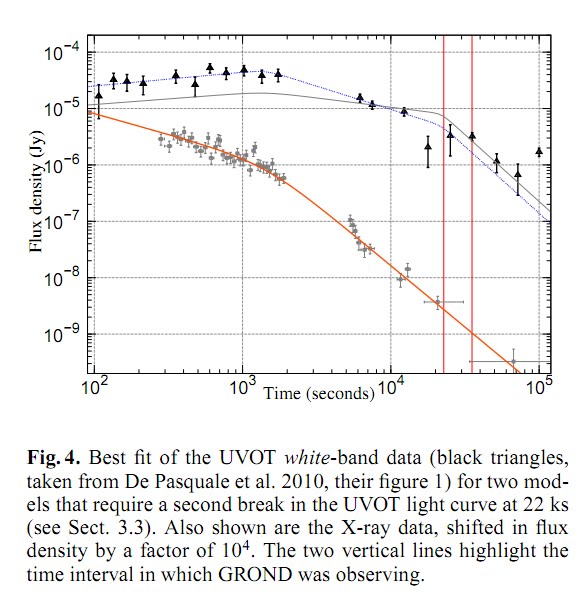
| Title: | The late-time afterglow of the extremely energetic short burst GRB 090510 revisited | |
| Authors: | Nicuesa Guelbenzu, A.; Klose, S.; Kruehler, T.; Greiner, J.; Rossi, A.; Kann, D. A.; Olivares E., F.; Rau, A.; Afonso, P. M. J.;Elliott, J.; Filgas, R.; Kuepcue Yoldas, A.; McBreen, S.; Nardini, M.; Schady, P.; Schmidl, S.; Sudilovsky, V.; Updike, A. C.;Yoldas, A. | |
| Publication: | eprint arXiv:1201.3885 | |
| Publication Date: | 01/2012 | |
| Origin: | ARXIV | |
| Keywords: | Astrophysics - High Energy Astrophysical Phenomena | |
| Comment: | submitted to Astronomy & Astrophysics, accepted for publication on Dec 24, 2011 | |
| Bibliographic Code: | 2012arXiv1201.3885N |
| Bibtex entry for this abstract Preferred format for this abstract (see Preferences) |
记得Tsvi他们曾经做过超新星作为超高能辐射的来源的,它们只能来自于银河系,或者较近的其它星系。但是为什么不能是伽马暴呢?
不过很可能不行,不然他们更自然地应该认为是伽马暴而不是超新星。(可能是爆发率的问题,银河系一百万年才有一次伽马暴,而超新星的频率更高。)
主要内容:
说宿主星系都是低质量的star forming system,比field galaxy的平均质量都小。SFR,甚至specific star formation rate都比别人低。
为什么呢?
我觉得其它高SFR的星系应该有更多的伽马暴。原因会不会是高SSFR的星系的尘埃比较多,伽马射线出不来呢?
"the dust-uncorrected UV SFR"和做了修正的区别大吗?这里的SFR的范围是10-2 M sun yr-1 < SFR < 10 M sun yr-1. 但是看另一篇文章,却是(0.03,300)!见ADS 2011ApJ...735L...8K, 或者:2010AJ....140.1557L
精彩摘抄:


| · Find Similar Abstracts (with default settings below) |
| Title: | On the Distribution of Stellar Masses in Gamma-ray Burst Host Galaxies | |
| Authors: | Castro Cerón, J. M.; Michałowski, M. J.; Hjorth, J.; Malesani, D.; Gorosabel, J.; Watson, D.;Fynbo, J. P. U.; Morales Calderón, M. | |
| Affiliation: | AA(Dark Cosmology Centre, Niels Bohr Institute, University of Copenhagen, Juliane Maries Vej 30, DK-2100 Copenhagen Ø, Denmark;...) | |
| Publication: | The Astrophysical Journal, Volume 721, Issue 2, pp. 1919-1927 (2010). (ApJ Homepage) | |
| Publication Date: | 10/2010 | |
| Origin: | IOP | |
| ApJ Keywords: | cosmology: observations, dust, extinction, galaxies: fundamental parameters, galaxies: ISM, gamma-ray burst: general, infrared: galaxies | |
| DOI: | 10.1088/0004-637X/721/2/1919 | |
| Bibliographic Code: | 2010ApJ...721.1919C |
| Bibtex entry for this abstract Preferred format for this abstract (see Preferences) |
主要内容:
短于0.1秒的暴。但是从空间分布等来看,可能也就是一般的短暴。
也许可以分析一下它们的spectral time lag,因为他们时标比较短,比较容易分辨。
精彩摘抄:
文章信息:
| · Find Similar Abstracts (with default settings below) |
| Title: | Observational constraints on the nature of very short gamma-ray bursts | |
| Authors: | Czerny, Bo\. zena; Janiuk, Agnieszka; Cline, David B.; Otwinowski, Stan | |
| Publication: | eprint arXiv:1006.1470 | |
| Publication Date: | 06/2010 | |
| Origin: | ARXIV | |
| Keywords: | Astrophysics - High Energy Astrophysical Phenomena | |
| Comment: | 25 pages, 14 figures; accepted to New Astronomy | |
| Bibliographic Code: | 2010arXiv1006.1470C |
| Bibtex entry for this abstract Preferred format for this abstract (see Preferences) |
| Sunday - September 13th | ||
| 18:00 - 20:00 | Registration & Welcome Cocktail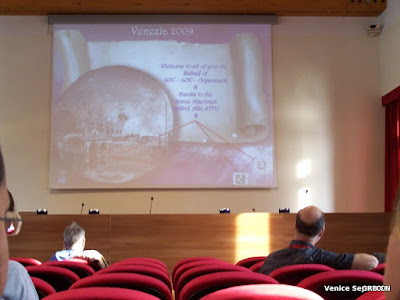 | |
| Monday - September 14th | ||
| 07:45 - 08:45 | Registration | |
| Chairman | M. Feroci | |
| 08:45 - 09:00 | G. Chincarini | Welcome 此人很像偷天陷阱里的男主角老头. 附剧照 http://posters.imdb.cn/jz/46852  |
| 09:00 - 09:35 | M. Lyutikov | GRB: observational progress and theoretical problems 主要内容大致有(这里以及以下都包含严重的偏见和记忆误差): 1. 一共有8个想080513这样的, 可能是短暴加一个tail; 2. 暴本身阶段的低频端的硬谱可能来自电子的分布; 3.说080916C的同步辐射模型是不行的 |
| 09:35 - 09:50 | I. Steele | Optical polarization measurements of GRB060418 and GRB090102 他们利物浦的望远镜加了偏振片, 这是两个观测. 其中060418的小于8%, 最令人惊讶的是090102的有10%, 而且致信度还很高!  |
| 09:50 - 10:05 | C. Guidorzi | The controversial link between prompt optical and gammarays: temporal study of GRB 080319B 说这个暴的光变里有3.3s的周期现象. 下图是time lag  |
| 10:05 - 10:30 | Coffee Break | |
| 10:30 - 10:55 | S. Barthelmy | GRB Prompt Emission and Swift-BAT 图左显示了三个仪器的分布和E_p的分布  1. 统计上, pulse的宽度 W~E_p^-0.4~z^0.4 2. 谱形上, cutoff power law的比Band的还多 3. 观测上, Swift的高红移的暴并没有更软 (这个可能说明E_p比较大, 即使红移比较高, 还是没看到peak的地方; 或者谱整个是一个比较好的幂律, 这样也不会看到变软; 或者, 当然最直接的解释应该是高红移的暴本身比较硬.) 4. 他们Swift在准备 sub-threshold, 就是不要那么强的伽玛光子信号就触发. 这样可以看到更多弱暴, 虽然会有很多误触发. |
| 10:55 - 11:20 | S. Kobayashi | Magnetized Fireballs and Early Afterglows |
| 11:20 - 11:45 | A. Pe'er | Observations, theory and implications of thermal emission from gamma-ray bursts 他主要还是说他的Themal component |
| 11:45 - 12:05 | L. Amati | Spectrum-energy correlation in GRB: status and perspectives 会议上有两个报告说Amati关系不对, 让他很郁闷. 在Tsvi的报告提问阶段都快结束后强烈要求发言, 终于给他机会, 说了很大一通. 最后说你们不能这样, 搞的让大家以为我这个关系真的就是错的样. Tsvi听了半天, 然后回了一句话, 闪人. 没听大明白, 大意是它是错的就是错的.  |
| 12:05 - 12:30 | J. Racusin | Jet Breaks and Energetics of Swift GRB X-ray Afterglows |
| 12:30 - 12:45 | D. Burrows | Chandra Searches for Jet Breaks 几类光变所占的比例.  |
| 12:45 - 13:00 | P. Evans | Confronting GRB afterglow models with a complete set of XRT light curves and hardness ratios |
| 13.00 - 14.20 | Lunch | |
| Chairman | S. Barthelmy | |
| 14:20 - 14:45 | A. MacFadyen | GRB Afterglow Lightcurves from Multi-Dimensional Simulations |
| 14:45 - 15:10 | R. Margutti | GRB temporal structure: flares and short term variability |
| 15:10 - 15:30 | R. Yamazaki | Prior Emission Model for the Plateau Phase in the X-ray Afterglow |
| 15:30 - 15:55 | E. Del Monte | The observation of Gamma Ray Bursts with AGILE |
| 15:55 - 16:10 | R. Klebesadel | The Discovery of Cosmic Gamma-Ray Bursts 此人算是伽玛暴的开山鼻祖, 1973?年发表了第一篇观测到伽玛暴的文章. 不知道会议组怎么这么有能耐, 居然能请到他来. 讲完后以及提问完后迎来了会上最长时间的掌声, 起码有一分钟. 具体内容不是很有意思, 提问还是蛮有意思的. Kouveliotou问他为什么那么晚才发文章, 他解释说忙, 还有因为计算机故障还是什么. 据说还有另外的版本, 说是因为军事机密问题, 不能发. (参见伽玛暴的发现的相关内容) 由于Vela是军事卫星, 主要目的是看前苏联有没有搞秘密核试验. 所以有人就问那你们到底看到了没有, 他坚决不泄密.    |
| 16:10 - 16:35 | Coffee Break | |
| 16:35 - 17:00 | F. Daigne | The prompt emission of gamma-ray bursts in the internal shock model |
| 17:00 - 17:15 | S. Sugita | Timing and spectral analysis of Short GRB and Multi-spiked Long GRB |
| 17:15 - 17:30 | E. Liang | Single Power-Law Decaying XRT lightcurves and Implications for the Unified Origin of the X-rays |
| 17:30 - 17:45 | P. Roming | A Large Homogenous Sample of Optical GRB Afterglow Light Curves |
| 17:45 - 18:00 | M. De Pasquale | Chromatic evolution in GRB afterglows |
| 18:00 - 18:20 | S. Covino | Optical observations of GRB afterglows |
| 18:20 - 18:35 | J. Nousek | Status of the Swift Mission |
| Tuesday - September 15th | ||
| Chairman | P. Michelson | |
| 09:00 - 09:25 | N. Omodei | Gamma-Ray Burst at HighEnergy: the Fermi LAT first observation of the shocking Universe |
| 09:25 - 09:45 | N. Kawai | Pulse structures of GRB 080916C observed with Fermi LAT/GBM |
| 09:45 - 10:05 | S. Guiriec | GRB 090510, a short and hard burst detected by Fermi |
| 10:05 - 10:25 | F. De Palma | GRB 090902B, a long GRB with High Energy emission detected with Fermi |
| 10:25 - 11:00 | Coffee Break | |
| 11:00 - 11:20 | E. Bissaldi | GRB 090323 and GRB 090328: two ksec long high-energy GammaRay Bursts detected with Fermi |
| 11:20 - 11:45 | B. Paciesas | Fermi GBM results |
| 11:45 - 12:10 | M. Briggs | Spectral Evolution of Three Short GRBs on Fine Timescales |
| 12:10 - 12:30 | V. Connaughton | High-Energy Spectral signatures of LAT-detected short gamma-ray bursts |
| 12:30 - 12:55 | J. Granot | Some Implications of Fermi High-Energy GRB Observations |
| 12.55 - 14.20 | Lunch | |
| Chairman | R. Bellazzini | |
| 14:20 - 14:45 | K. Asano | Theoretical Interpretation for Fermi LAT-detected Gamma-ray Bursts |
| 14:45 - 15:10 | C. Dermer | Evidence for Ultra-High Energy Cosmic Ray Acceleration from Fermi Observations of GRBs    |
| 15:10 - 15:35 | P. Michelson | Fermi LAT results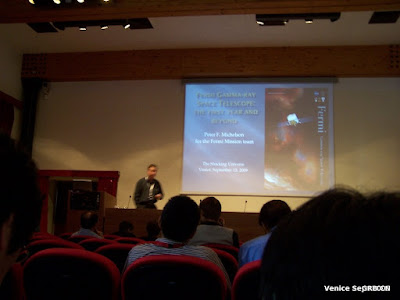   |
| 15:35 - 16:00 | B. Atwood | Fermi-LAT Analysis to Maximize GRB Science |
| 16:00 - 16:30 | Coffee Break | |
| 16:30 - 16:50 | D. Kocevski | LAT Upper Limits to GRBs |
| 16:50 - 17:05 | T. Aune | Constraints on GeV-TeV Emission from the "nakedeye" GRB 080319B |
| 17:05 - 17:30 | Y. Fan | Interpretation and implication of the non-detection of GeV spectrum excess by Fermi gamma-ray Space Telescope in most GRBs   |
| 17:30 - 17:45 | A. Melandri | The Rise and Fall of GRBs - Lorentz Factors and Fireball Shock Physics |
| 17:45 - 18:10 | R. Barniol-Duran | High energy photons from Fermi GRBs: Who would have thought that they were produced in the external shock?  |
| 19:15 | Visit at the S. Marco Basilica | |
| Wednesday - September 16th | ||
| Chairman | P. Roming | |
| 09:00 - 09:30 | E. Berger | The Host Galaxies of Short GRBs: Implications for the Progenitors and Comparison to Long GRB Hosts |
| 09:30 - 09:45 | F. Virgili | Are all short GRBs of compact star merger origin? |
| 09:45 - 10:00 | P. D'Avanzo | Optical spectroscopy of short GRB afterglows |
| 10:00 - 10:20 | W. Lee | The role of winds and tidal tails from post merger disks in the production of outflows and late time flares in SGRBs |
| 10:20 - 10:40 | Poster competition | |
| 10:40 - 11:10 | Coffee Break | |
| 11:10 - 11:40 | C. Fryer | Neutrinos and Gravitational Waves from Long Duration GRBs |
| 11:40 - 12:05 | P. Vreeswijk | GRB optical afterglow spectroscopy and host galaxies: an unbiased approach |
| 12:05 - 12:20 | D. Perley | The Environments of Dark Gamma-Ray Bursts |
| 12:20 - 12:35 | A. De Ugarte Postigo | GRB 090313: X-shooter's first glimpse of a GRB |
| 12:35 - 13:15 | K. Hamaguchi | News on Eta-Carinae |
| 13:15 | Lunch | |
| 13:45 | Free Afternoon - Social Trip to S. Francesco del Deserto island | |
| Thursday - September 17th | ||
| Chairman | J. Osborne | |
| 09:00 - 09:25 | S. Savaglio | Gamma-Ray Burst Host Galaxies and the High Redshift Universe |
| 09:25 - 09:50 | A. Fruchter | Environments, Hosts, and their Implications for the Physics and Progenitors of GRBs |
| 09:50 - 10:05 | E. Levesque | Modeling the Host Galaxies of Long-Duration Gamma-Ray Bursts |
| 10:05 - 10:20 | P. Schady | Dust Extinction Properties within GRB Host Galaxies |
| 10:20 - 10:35 | K. Svensson | The host galaxies of core-collapse supernovae and gamma ray bursts |
| 10:35 - 11:00 | Coffee Break | |
| 11:00 - 11:30 | A. Soderberg | A Holistic View of the GRB-SN Connection |
| 11:30 - 11:55 | M. Della Valle | GRB-SN Connection: observational outcomes |
| 11:55 - 12:15 | S. Nagataki | GRB-SN Connection: Central Engine of Long GRBs and Explosive Nucleosynthesis |
| 12:15 - 12:30 | A. Kamble | XRF080109/SN2008D : an investigation at radio frequencies |
| 12:30 - 12:45 | R. Shen | The late jet in GRBs and its interactions with a supernova ejecta and a cocoon |
| 12:45 - 13:00 | F. De Colle | Bipolar Supernova Explosions: Nucleosynthesis and the Role of Magnetic Fields |
| 13.00 - 14.30 | Lunch | |
| Chairman | N. Kawai | |
| 14:30 - 15:00 | P. Kumar | The Physics of GRB Prompt Emission |
| 15:00 - 15:30 | B. Zhang | GRB prompt emission models: from low sigma to high sigma |
| 15:30 - 16:00 | T. Piran | TBA |
| 16:00 - 16:30 | Coffee Break | |
| 16:30 - 16:45 | E. Nakar | Introduction for a debate |
| 16:45 - 17:20 | Debate: where do we stand? | |
| 17:20 - 17:35 | A. Levan | Illuminating the dark ages with GRB 090423 |
| 17:35 - 17:50 | R. Salvaterra | GRB 090423 reveals an exploding star at the epoch of reionization |
| 17:50 - 18:05 | D. Frail | Discovery of the Radio Afterglow from GRB 090423 |
| 18:05 - 18:20 | A. Cucchiara | GRB 090429B as the second "extreme redshift" gamma-ray burst |
| 18:20 - 18:45 | T. Totani | GRBs and High Redshift Universe: High Redshift Galaxies, Pop III Stars, and Reionization |
| 20:30 | Social Dinner | |
| Friday - September 18th | ||
| Chairman | K. Hurley | |
| 08:45 - 09:10 | C. Kouveliotou | Magnetar Observations with Fermi/GBM      |
| 09:10 - 09:25 | S. Dall'Osso | Magnetars at birth as strong sources of Gravitation Wave Radiation |
| 09:25 - 09:40 | Y. Nakagawa | Suzaku Observations of Short Bursts from SGR 0501+4516 |
| 09:40 - 10:10 | E. Ramirez-Ruiz | Compact Objects in The Era of Celestial Cinematography |
| 10:10 - 10:40 | Coffee Break | |
| 10:40 - 11:05 | V. D'Elia | UVES-VLT High Resolution Spectroscopy of Gamma-Ray Burst afterglows: host galaxies and intervening absorbers |
| 11:05 - 11:20 | S. Vergani | Statistics and characteristics of MgII absorbers along GRB lines of sight observed with VLT-UVES |
| 11:20 - 11:35 | S. Campana | Circumburst ambient surrounding GRBs in the X-ray band |
| 11:35 - 11:50 | C. Thoene | GRB 090426 - a new class or a strange environment? |
| 11:50 - 12:00 | I. Horvath | GRB groups observed by BATSE, BeppoSAX and Swift |
| 12:00 - 12:15 | D. Lopez-Camara | Quiescence and late time activity in collapsars due to critical angular momentum distributions |
| 12:15 - 12:30 | G. Beskin | Discovery of the "central engine" manifestation in the Naked-Eye Burst prompt optical emission |
| 12.30 - 14.00 | Lunch | |
| Chairman | D. Burrows | |
| 14:00 - 14:25 | K. Yamaoka | Suzaku observations of GRB prompt emissions and X-ray afterglows |
| 14:25 - 14:55 | C. Bianco | The extended afterglow luminosity evolution over the equitemporal surfaces |
| 14:55 - 15:10 | F. Genet | Steep decay phase and prompt emission models |
| 15:10 - 15:25 | V. Mangano | Modeling the spectral evolution in the decaying tails of Swift GRBs |
| 15:25 - 15:45 | S. Inoue | Probing UV radiation fields and magnetic fields in the era of first star formation through GeV γ-rays from very high-z GRBs |
| 15:45 - 16:00 | P. Romano | Supergiant Fast X-ray Transients: the Swift monitoring program |
| 16:00 - 16:45 | N. Gehrels | Concluding Remarks |