伽玛暴(Gamma-Ray Burst)笔记。记录有关伽玛暴的新文章,另外也包括看的老文章、自己的想法、以及跟天文相关的一些东西。 Feel free to leave me a message by comments or by email.

显示标签为“3.4 spectrum”的博文。显示所有博文

星期六, 二月 08, 2014

Gruber 2013 Fermi GBM的谱的catalog

主要内容:
900多个暴,7500个谱。

精彩摘抄:


文章信息:

· Find Similar Abstracts (with default settings below)
· arXiv e-print (arXiv:1401.5069)
· References in the Article
· Also-Read Articles (Reads History)
·
· Translate This Page
Title:
The Fermi GBM Gamma-Ray Burst Spectral Catalog: Four Years Of Data
Authors:
Gruber, David; Goldstein, Adam; Weller von Ahlefeld, Victoria; Narayana Bhat, P.; Bissaldi, Elisabetta; Briggs, Michael S.; Byrne, Dave; Cleveland, William H.; Connaughton, Valerie; Diehl, Roland; Fishman, Gerald J.; Fitzpatrick, Gerard; Foley, Suzanne; Gibby, Melissa; Giles, Misty M.; Greiner, Jochen; Guiriec, Sylvain; van der Horst, Alexander J.; von Kienlin, Andreas; Kouveliotou, Chryssa; Layden, Emily; Lin, Lin; Meegan, Charles A.; McGlynn, Sinéad; Paciesas, William S.; Pelassa, Véronique; Preece, Robert D.; Rau, Arne; Wilson-Hodge, Colleen A.; Xiong, Shaolin; Younes, George; Yu, Hoi-Fung
Publication:
eprint arXiv:1401.5069
Publication Date:
01/2014
Origin:
ARXIV
Keywords:
Astrophysics - High Energy Astrophysical Phenomena
Comment:
Accepted for publication in ApJS
Bibliographic Code:
2014arXiv1401.5069G

Abstract

In this catalog we present the updated set of spectral analyses of GRBs detected by the Fermi Gamma-Ray Burst Monitor (GBM) during its first four years of operation. It contains two types of spectra, time-integrated spectral fits and spectral fits at the brightest time bin, from 943 triggered GRBs. Four different spectral models were fitted to the data, resulting in a compendium of more than 7500 spectra. The analysis was performed similarly, but not identically to Goldstein et al. 2012. All 487 GRBs from the first two years have been re-fitted using the same methodology as that of the 456 GRBs in years three and four. We describe, in detail, our procedure and criteria for the analysis, and present the results in the form of parameter distributions both for the observer-frame and rest-frame quantities. The data files containing the complete results are available from the High-Energy Astrophysics Science Archive Research Center (HEASARC).

Bibtex entry for this abstract   Preferred format for this abstract (see Preferences)

星期五, 二月 07, 2014

Sparre 2014 of GRB 111008A的DLA吸收系统

主要内容:
可以从这些谱上探测路上环境。

精彩摘抄:


文章信息:
· Find Similar Abstracts (with default settings below)
· arXiv e-print (arXiv:1309.2940)
· References in the Article
· Citations to the Article (2) (Citation History)
· Refereed Citations to the Article
· Also-Read Articles (Reads History)
·
· Translate This Page
Title:
Two high-redshift DLAs towards a z~5 gamma-ray burst
Authors:
Sparre, M.; Hartoog, O. E.; Krühler, T.; Fynbo, J. P. U.; Watson, D. J.; Wiersema, K.; D'Elia, V.; De Cia, A.; Afonso, P. M. J.; Covino, S.; de Ugarte Postigo, A.; Flores, H.; Goldoni, P.; Greiner, J.; Hjorth, J.; Jakobsson, P.; Kaper, L.; Klose, S.; Malesani, D.; Milvang-Jensen, B.; Nardini, M.; Piranomonte, S.; Sollerman, J.; Sanchez Ramirez, R.; Schulze, S.; Tanvir, N. R.; Vergani, S. D.; Wijers, R. A. M. J.; Zafar, T.
Publication:
eprint arXiv:1309.2940
Publication Date:
09/2013
Origin:
ARXIV
Keywords:
Astrophysics - Cosmology and Extragalactic Astrophysics
Comment:
13 pages, 9 figures, Submitted to ApJ
Bibliographic Code:
2013arXiv1309.2940S

Abstract

Observations of the afterglows of long gamma-ray bursts (GRBs) allow the study of star-forming galaxies across most of cosmic history. Here we present observations of GRB 111008A from which we can measure abundance patterns, metallicity, dust content and extinction of the GRB host galaxy (z=5.0) as well as a Damped Lyman-alpha Absorber (DLA) galaxy along the line of sight (z=4.6). These systems have column densities of log N =22.30 +/- 0.06 and 21.34 +/- 0.10, respectively. The GRB host galaxy has a metallicity of 2% solar (based on sulfur), and a lower limit of the metallicity for the intervening DLA is 3% (based on silicon). For the intervening absorber we also measure -1.73<[Fe/H]<-1.09, but the true metallicity can be higher, because it is unclear how much the abundances are affected by dust depletion. The presence and variability of fine-structure lines confirms the z=5.0 system as the GRB host. This is the highest redshift where Fe II fine-structure lines have been detected. The afterglow is only mildly reddened with A_V = 0.11 +/- 0.04 mag, and the host galaxy has a dust-to-metals ratio which is consistent with being equal to or lower than typical values in the Local Group.

Bibtex entry for this abstract   Preferred format for this abstract (see Preferences)

Bošnjak 2014 INTEGRAL暴的谱的catalog

主要内容:


精彩摘抄:


文章信息:
· Find Similar Abstracts (with default settings below)
· Electronic Refereed Journal Article (HTML)
· Full Refereed Journal Article (PDF/Postscript)
· arXiv e-print (arXiv:1309.3174)
· References in the article
· Also-Read Articles (Reads History)
·
· Translate This Page
Title:
The spectral catalogue of INTEGRAL gamma-ray bursts. results of the joint IBIS/SPI spectral analysis
Authors:
Bošnjak, Ž.; Götz, D.; Bouchet, L.; Schanne, S.; Cordier, B.
Affiliation:
AA(AIM (UMR 7158 CEA/DSM-CNRS-Université Paris Diderot) Irfu/Service d'Astrophysique, Saclay, 91191, Gif-sur-Yvette Cedex, France zeljka.bosnjak@cea.fr; Department of Physics, University of Rijeka, 51000, Rijeka, Croatia; Université de Toulouse, UPS-OMP, IRAP, 31028, Toulouse, France), AB(AIM (UMR 7158 CEA/DSM-CNRS-Université Paris Diderot) Irfu/Service d'Astrophysique, Saclay, 91191, Gif-sur-Yvette Cedex, France), AC(Université de Toulouse, UPS-OMP, IRAP, 31028, Toulouse, France; CNRS, IRAP, 9 Av. Colonel Roche, BP 44346, 31028, Toulouse Cedex 4, France), AD(AIM (UMR 7158 CEA/DSM-CNRS-Université Paris Diderot) Irfu/Service d'Astrophysique, Saclay, 91191, Gif-sur-Yvette Cedex, France), AE(AIM (UMR 7158 CEA/DSM-CNRS-Université Paris Diderot) Irfu/Service d'Astrophysique, Saclay, 91191, Gif-sur-Yvette Cedex, France)
Publication:
Astronomy & Astrophysics, Volume 561, id.A25, 15 pp. (A&A Homepage)
Publication Date:
01/2014
Origin:
EDP Sciences
Astronomy Keywords:
methods: data analysis, gamma-ray burst: general, catalogs
DOI:
10.1051/0004-6361/201322256
Bibliographic Code:
2014A&A...561A..25B

Abstract

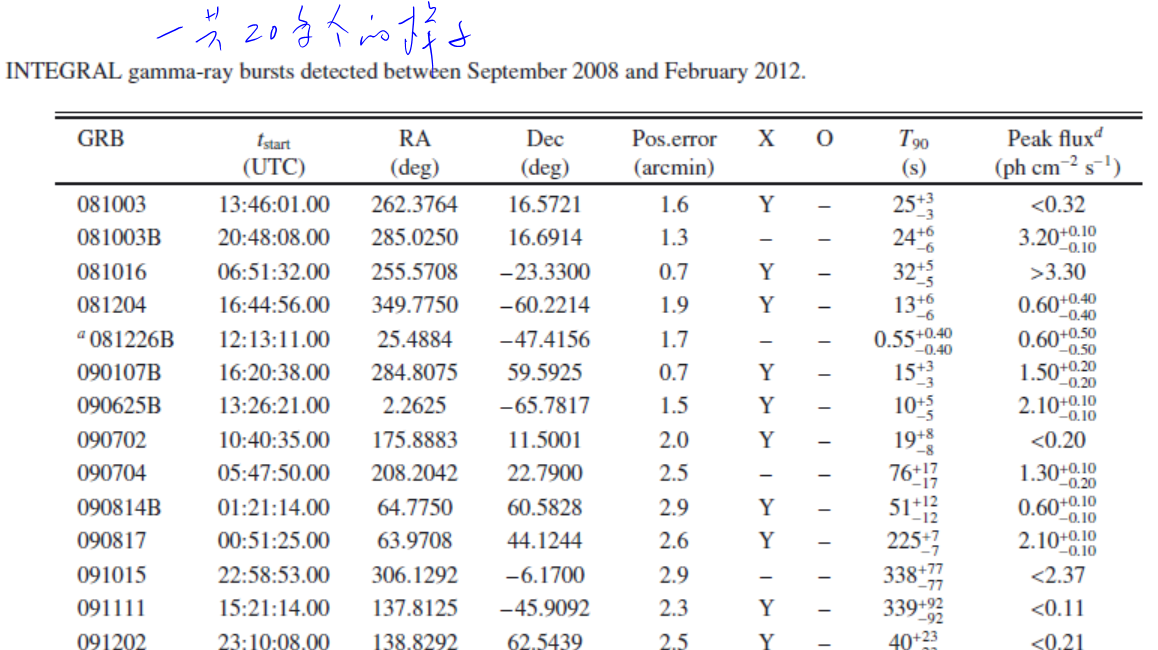
We present the updated INTEGRAL catalogue of gamma-ray bursts (GRBs) observed between December 2002 and February 2012. The catalogue contains the spectral parameters for 59 GRBs localized by the INTEGRAL Burst Alert System (IBAS). We used the data from the two main instruments on board the INTEGRAL satellite: the spectrometer SPI (SPectrometer on INTEGRAL) nominally covering the energy range 20 keV-8 MeV, and the imager IBIS (the Imager on Board the INTEGRAL Satellite) operating in the range from 15 keV to 10 MeV. For the spectral analysis we applied a new data extraction technique, developed to explore the energy regions of highest sensitivity for both instruments, SPI and IBIS. It allowed us to analyse the GRB spectra over a broad energy range and to determine the bursts' spectral peak energies. The spectral analysis was performed on the whole sample of GRBs triggered by IBAS, including all the events observed in the period December 2002 to February 2012. The catalogue contains the trigger times, burst coordinates, positional errors, durations, and peak fluxes for 28 unpublished GRBs observed between September 2008 and February 2012. The light curves in the 20-200 keV energy band of these events were derived using IBIS data. We compare the prompt emission properties of the INTEGRAL GRB sample with the BATSE and Fermi samples.

Bibtex entry for this abstract   Preferred format for this abstract (see Preferences)

星期四, 二月 06, 2014

Goldstein, Adam 2013 BATSE 5B的伽马暴谱的catalog

主要内容:
给出了2145个BATSE暴的19000个谱,一个暴可以分时段有多个谱。分别用五种不同的谱进行了拟合,得到了相应的参数。

精彩摘抄:


文章信息:
· Find Similar Abstracts (with default settings below)
· Electronic Refereed Journal Article (HTML)
· Full Refereed Journal Article (PDF/Postscript)
· arXiv e-print (arXiv:1311.7135)
· On-line Data
· References in the article
· Citations to the Article (2) (Citation History)
· Refereed Citations to the Article
· SIMBAD Objects (14)
· Associated Articles
· Also-Read Articles (Reads History)
·
· Translate This Page
Title:
The BATSE 5B Gamma-Ray Burst Spectral Catalog
Authors:
Goldstein, Adam; Preece, Robert D.; Mallozzi, Robert S.; Briggs, Michael S.; Fishman, Gerald J.; Kouveliotou, Chryssa; Paciesas, William S.; Burgess, J. Michael
Affiliation:
AA(University of Alabama in Huntsville, 320 Sparkman Drive, Huntsville, AL 35899, USA), AB(University of Alabama in Huntsville, 320 Sparkman Drive, Huntsville, AL 35899, USA), AC(Deceased.), AD(University of Alabama in Huntsville, 320 Sparkman Drive, Huntsville, AL 35899, USA), AE(Space Science Office, VP62, NASA/Marshall Space Flight Center, Huntsville, AL 35812, USA), AF(Space Science Office, VP62, NASA/Marshall Space Flight Center, Huntsville, AL 35812, USA), AG(Universities Space Research Association, 320 Sparkman Drive, Huntsville, AL 35805, USA), AH(University of Alabama in Huntsville, 320 Sparkman Drive, Huntsville, AL 35899, USA)
Publication:
The Astrophysical Journal Supplement, Volume 208, Issue 2, article id. 21, 30 pp. (2013). (ApJS Homepage)
Publication Date:
10/2013
Origin:
IOP
Astronomy Keywords:
gamma-ray burst: general, methods: data analysis
DOI:
10.1088/0067-0049/208/2/21
Bibliographic Code:
2013ApJS..208...21G

Abstract

We present systematic spectral analyses of gamma-ray bursts (GRBs) detected with the Burst and Transient Source Experiment (BATSE) on board the Compton Gamma-Ray Observatory during its entire nine years of operation. This catalog contains two types of spectra extracted from 2145 GRBs, and fitted with five different spectral models resulting in a compendium of over 19,000 spectra. The models were selected based on their empirical importance to the spectral shape of many GRBs, and the analysis performed was devised to be as thorough and objective as possible. We describe in detail our procedures and criteria for the analyses, and present the bulk results in the form of parameter distributions. This catalog should be considered an official product from the BATSE Science Team, and the data files containing the complete results are available from the High-Energy Astrophysics Science Archive Research Center (HEASARC).

Associated Articles

Source Paper     Catalog Description    

Bibtex entry for this abstract   Preferred format for this abstract (see Preferences)

星期四, 六月 28, 2012

2012 Levinson 光球层的热辐射

主要内容:
也能产生Band 谱。
这篇文章应该仔细读。

精彩摘抄:


文章信息:


· Find Similar Abstracts (with default settings below)
· arXiv e-print (arXiv:1205.3227)
· References in the Article
· Also-Read Articles (Reads History)
·
· Translate This Page
Title:
Observational signatures of sub-photospheric radiation mediated shocks in the prompt phase of GRBs
Authors:
Levinson, Amir
Publication:
eprint arXiv:1205.3227
Publication Date:
05/2012
Origin:
ARXIV
Keywords:
Astrophysics - High Energy Astrophysical Phenomena
Comment:
23 pages, 5 figures, revised version with an error corrected and additional results presented
Bibliographic Code:
2012arXiv1205.3227L

Abstract

A shock that form below the photosphere of a GRB outflow is mediated by Compton scattering of radiation advected into the shock by the upstream fluid. The characteristic scale of such a shock, a few Thomson depths, is larger than any kinetic scale involved by several orders of magnitudes, hence, unlike collisionless shocks, radiation mediated shocks cannot accelerate particles to non-thermal energies. The spectrum emitted by a shock that emerges from the photosphere of a GRB jet, reflects the temperature profile downstream of the shock, with a possible contribution at the highest energies from the shock transition layer itself. We study the properties of radiation mediated shocks that form during the prompt phase of GRBs, and compute the time integrated spectrum emitted by the shocked fluid following shock breakout. We show that the time integrated emission from a single shock exhibits a prominent thermal peak, with the location of the peak depending on the shock velocity profile. We also point out that multiple shock emission can produce a spectrum that mimics a Band spectrum.
Bibtex entry for this abstract   Preferred format for this abstract (see Preferences)

星期四, 二月 09, 2012

Larsson, J. 2011 GRB 061007的热谱成分

主要内容:
这个暴用热谱拟合和用Band谱拟合一样好。

精彩摘抄:


文章信息:

· Find Similar Abstracts (with default settings below)
· Electronic Refereed Journal Article (HTML)
· Full Refereed Journal Article (PDF/Postscript)
· arXiv e-print (arXiv:1102.4739)
· On-line Data
· References in the article
· Citations to the Article (1) (Citation History)
· Refereed Citations to the Article
· SIMBAD Objects (4)
· Also-Read Articles (Reads History)
·
· Translate This Page
Title:
Spectral components in the bright, long GRB 061007: properties of the photosphere and the nature of the outflow
Authors:
Larsson, J.; Ryde, F.; Lundman, C.; McGlynn, S.; Larsson, S.;
Affiliation:
AA(Department of Astronomy, Stockholm University,
Publication:
Monthly Notices of the Royal Astronomical Society, Volume 414, Issue 3, pp. 2642-2649. (MNRAS Homepage)
Publication Date:
07/2011
Origin:
WILEY
Astronomy Keywords:
radiation mechanisms: general, gamma-ray burst: individual: GRB 061007
Abstract Copyright:
© 2011 The Authors Monthly Notices of the Royal Astronomical Society © 2011 RAS
DOI:
10.1111/j.1365-2966.2011.18582.x
Bibliographic Code:
2011MNRAS.414.2642L

Abstract

We present a time-resolved spectral analysis of the bright, long GRB 061007 (z= 1.261) using Swift and Suzaku data. We find that the prompt emission of the burst can be equally well explained by a photospheric component together with a power law as by a Band function, and we explore the implications of the former model. The photospheric component, which we model with a multicolour blackbody, dominates the spectra and has a very stable shape throughout the burst. This component provides a natural explanation for the hardness-intensity correlation seen within the burst and also allows us to estimate the bulk Lorentz factor and the radius of the photosphere. The power-law component dominates the fit at high energies and has a nearly constant slope of -1.5. We discuss the possibility that this component is of the same origin as the high-energy power laws recently observed in some Fermi bursts.
Bibtex entry for this abstract   Preferred format for this abstract (see Preferences)

星期二, 二月 07, 2012

Ghirlanda, G. 2011 Fermi暴的E_p随光变的演化

主要内容:
对Fermi的23个暴(11长12短)的分析,发现有相同的行为:E_p和flux正相关;没有从硬到软的演化。

精彩摘抄:


文章信息:

· Find Similar Abstracts (with default settings below)
· Electronic Refereed Journal Article (HTML)
· Full Refereed Journal Article (PDF/Postscript)
· arXiv e-print (arXiv:1109.1833)
· References in the article
· Also-Read Articles (Reads History)
·
· Translate This Page
Title:
Short and long gamma-ray bursts: same emission mechanism?
Authors:
Ghirlanda, G.; Ghisellini, G.; Nava, L.
Affiliation:
AA(INAF - Osservatorio Astronomico di Brera, Via E. Bianchi 46, I-23807 Merate, Italy), AB(INAF - Osservatorio Astronomico di Brera, Via E. Bianchi 46, I-23807 Merate, Italy), AC(SISSA - via Bonomea 265, I-34136 Trieste, Italy)
Publication:
Monthly Notices of the Royal Astronomical Society: Letters, Volume 418, Issue 1, pp. L109-L113. (MNRAS Homepage)
Publication Date:
11/2011
Origin:
WILEY
Astronomy Keywords:
radiation mechanisms: non-thermal, stars: gamma-ray bursts: general
Abstract Copyright:
© 2011 The Authors Monthly Notices of the Royal Astronomical Society © 2011 RAS
DOI:
10.1111/j.1745-3933.2011.01154.x
Bibliographic Code:
2011MNRAS.418L.109G

Abstract

We study the spectral evolution on second and subsecond time-scales in 11 long and 12 short gamma-ray bursts (GRBs) with peak flux >8.5 × 10⁻⁶ erg cm-2 s (8 keV-35 MeV) detected by the Fermi satellite. The peak flux correlates with the time-averaged peak energy in both classes of bursts. The peak energy evolution, as a function of time, tracks the evolution of the flux on short time-scales in both short and long GRBs. We do not find evidence of a hard-to-soft spectral evolution. While short GRBs have observed peak energies larger than few MeV during most of their evolution, long GRBs can start with a softer peak energy (of few hundreds keV) and become as hard as short ones (i.e. with Eobspeak larger than few MeV) at the peak of their light curve. Six GRBs in our sample have a measured redshift. In these few cases we find that their correlations between the rest frame Epeak and the luminosity Liso are less scattered than their correlations in the observer frame between the peak energy Eobspeak and the flux P. We find that the rest frame Epeak of long bursts can be as high or even larger than that of short GRBs and that short and long GRBs follow the same Epeak(t)-Liso(t) correlation, despite the fact that they likely have different progenitors.
Bibtex entry for this abstract   Preferred format for this abstract (see Preferences)

星期日, 二月 05, 2012

Basak, Rupal 2011 暴本身光变的Timing分析

主要内容:
应用于Fermi时代最亮的暴 090618
说还可以作为标准烛光。

精彩摘抄:


文章信息:

· Find Similar Abstracts (with default settings below)
· Electronic On-line Article (HTML)
· arXiv e-print (arXiv:1110.1994)
· References in the Article
· Also-Read Articles (Reads History)
·
· Translate This Page
Title:
Measuring the pulse of GRB 090618: A Simultaneous Spectral and Timing Analysis of the Prompt Emission
Authors:
Basak, Rupal; Rao, A. R.
Publication:
eprint arXiv:1110.1994
Publication Date:
10/2011
Origin:
ARXIV
Keywords:
Astrophysics - High Energy Astrophysical Phenomena
Comment:
18 pages, 4 tables, 11 figures, accepted for publication in ApJ
Bibliographic Code:
2011arXiv1110.1994R

Abstract

We develop a new method for simultaneous timing and spectral studies of Gamma Ray Burst (GRB) prompt emission and apply it to make a pulse-wise description of the prompt emission of GRB 090618, the brightest GRB detected in the Fermi era. We exploit the large area (and sensitivity) of Swift/BAT and the wide band width of Fermi/GBM to derive the parameters for a complete spectral and timing description of the individual pulses of this GRB, based on the various empirical relations suggested in the literature. We demonstrate that this empirical model correctly describes the other observed properties of the burst like the variation of the lag with energy and the pulse width with energy. The measurements also show an indication of an increase in pulse width as a function of energy at low energies for some of the pulses, which is naturally explained as an off-shoot of some particular combination of the model parameters. We argue that these model parameters, particularly the peak energy at the beginning of the pulse, are the natural choices to be used for correlation with luminosity. The implications of these results for the use of GRBs as standard candles are briefly described.
Bibtex entry for this abstract   Preferred format for this abstract (see Preferences)