伽玛暴(Gamma-Ray Burst)笔记。记录有关伽玛暴的新文章,另外也包括看的老文章、自己的想法、以及跟天文相关的一些东西。 Feel free to leave me a message by comments or by email.

显示标签为“4.6 host galaxy”的博文。显示所有博文

星期六, 二月 08, 2014

Krongold 2013 X射线和光学所推出的介质柱密度不同的原因

主要内容:
X射线的比光学的高出10倍。(是不是如果没电离,对光学来说就是透明的?)

精彩摘抄:


文章信息:

· Find Similar Abstracts (with default settings below)
· Electronic Refereed Journal Article (HTML)
· Full Refereed Journal Article (PDF/Postscript)
· arXiv e-print (arXiv:1307.7199)
· References in the article
· SIMBAD Objects (4)
· Also-Read Articles (Reads History)
·
· Translate This Page
Title:
An Explanation for the Different X-Ray to Optical Column Densities in the Environments of Gamma Ray Bursts: A Progenitor Embedded in a Dense Medium
Authors:
Krongold, Yair; Prochaska, J. Xavier
Affiliation:
AA(Instituto de Astronomia, Universidad Nacional Autonoma de Mexico, Apartado Postal 70-264, 04510 Mexico DF, Mexico xavier@ucolick.org), AB(Department of Astronomy and Astrophysics, UCO/Lick Observatory, University of California, 1156 High Street, Santa Cruz, CA 95064, USA)
Publication:
The Astrophysical Journal, Volume 774, Issue 2, article id. 115, 11 pp. (2013). (ApJ Homepage)
Publication Date:
09/2013
Origin:
IOP
Astronomy Keywords:
galaxies: ISM, gamma-ray burst: general
DOI:
10.1088/0004-637X/774/2/115
Bibliographic Code:
2013ApJ...774..115K

Abstract

We study the >~ 10 ratios in the X-ray to optical column densities inferred from afterglow spectra of gamma ray bursts (GRBs) due to gas surrounding their progenitors. We present time-evolving photoionization calculations for these afterglows and explore different conditions of their environment. We find that homogenous models of the environment (constant density) predict X-ray columns similar to those found in the optical spectra, with the bulk of the opacity being produced by neutral material at large distances from the burst. This result is independent of gas density or metallicity. Only models assuming a progenitor immersed in a dense (~102-4 cm-3) cloud of gas (with radius ~10 pc), with a strong, declining gradient of density for the surrounding interstellar medium (ISM) are able to account for the large X-ray to optical column density ratios. However, to avoid an unphysical correlation between the size of this cloud and the size of the ionization front produced by the GRB, the models also require that the circumburst medium is already ionized prior to the burst. The inferred cloud masses are <~ 106 M ⊙, even if low metallicities in the medium are assumed (Z ~ 0.1 Z ⊙). These cloud properties are consistent with those found in giant molecular clouds and our results support a scenario in which the progenitors reside within intense star formation regions of galaxies. Finally, we show that modeling over large samples of GRB afterglows may offer strong constraints on the range of properties in these clouds, and the host galaxy ISM.

Bibtex entry for this abstract   Preferred format for this abstract (see Preferences)

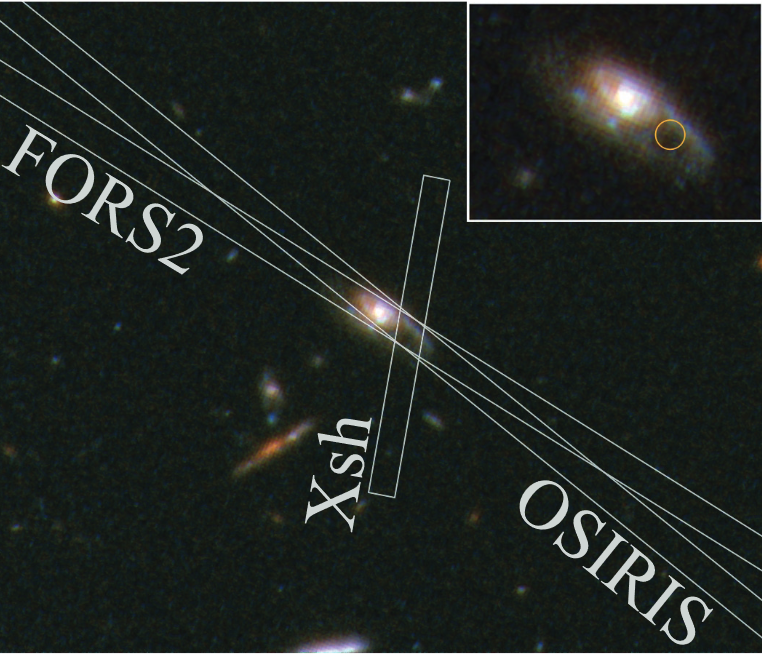
de Ugarte Postigo, A. 2013 GRB 130603B的宿主星系和环境及全方位观测

主要内容:
发现它还是在恒星形成区的,说明要么kick速度比较小,要么轨道比较短很快就并合了。

精彩摘抄:


文章信息:
· Find Similar Abstracts (with default settings below)
· arXiv e-print (arXiv:1308.2984)
· References in the Article
· Citations to the Article (6) (Citation History)
· Refereed Citations to the Article
· Also-Read Articles (Reads History)
·
· Translate This Page
Title:
Spectroscopy of the short-hard GRB 130603B: The host galaxy and environment of a compact object merger
Authors:
de Ugarte Postigo, A.; Thoene, C. C.; Rowlinson, A.; Garcia-Benito, R.; Levan, A. J.; Gorosabel, J.; Goldoni, P.; Schulze, S.; Zafar, T.; Wiersema, K.; Sanchez-Ramirez, R.; Melandri, A.; D'Avanzo, P.; Oates, S.; D'Elia, V.; De Pasquale, M.; Kruehler, T.; van der Horst, A. J.; Xu, D.; Watson, D.; Piranomonte, S.; Vergani, S.; Milvang-Jensen, B.; Kaper, L.; Malesani, D.; Fynbo, J. P. U.; Cano, Z.; Covino, S.; Flores, H.; Greiss, S.; Hammer, F.; Hartoog, O. E.; Hellmich, S.; Heuser, C.; Hjorth, J.; Jakobsson, P.; Mottola, S.; Sparre, M.; Sollerman, J.; Tagliaferri, G.; Tanvir, N. R.; Vestergaard, M.; Wijers, R. A. M. J.
Publication:
eprint arXiv:1308.2984
Publication Date:
08/2013
Origin:
ARXIV
Keywords:
Astrophysics - Cosmology and Extragalactic Astrophysics, Astrophysics - High Energy Astrophysical Phenomena
Comment:
Accepted for publication in Astronomy and Astrophysics
Bibliographic Code:
2013arXiv1308.2984D

Abstract

Short duration gamma-ray bursts (SGRBs) are thought to be related to the violent merger of compact objects, such as neutron stars or black holes, which makes them promising sources of gravitational waves. The detection of a 'kilonova'-like signature associated to the Swift-detected GRB 130603B has suggested that this event is the result of a compact object merger. Our knowledge on SGRB has been, until now, mostly based on the absence of supernova signatures and the analysis of the host galaxies to which they cannot always be securely associated. Further progress has been significantly hampered by the faintness and rapid fading of their optical counterparts (afterglows), which has so far precluded spectroscopy of such events. Afterglow spectroscopy is the key tool to firmly determine the distance at which the burst was produced, crucial to understand its physics, and study its local environment. Here we present the first spectra of a prototypical SGRB afterglow in which both absorption and emission features are clearly detected. Together with multiwavelength photometry we study the host and environment of GRB 130603B. From these spectra we determine the redshift of the burst to be z = 0.3565+/-0.0002, measure rich dynamics both in absorption and emission, and a substantial line of sight extinction of A_V = 0.86+/-0.15 mag. The GRB was located at the edge of a disrupted arm of a moderately star forming galaxy with near-solar metallicity. Unlike for most long GRBs (LGRBs), N_HX / A_V is consistent with the Galactic ratio, indicating that the explosion site differs from those found in LGRBs. The merger is not associated with the most star-forming region of the galaxy; however, it did occur in a dense region, implying a rapid merger or a low natal kick velocity for the compact object binary.

Bibtex entry for this abstract   Preferred format for this abstract (see Preferences)

Perley 2013 Keck对160暴的宿主星系的观测

主要内容:


精彩摘抄:


文章信息:
· Find Similar Abstracts (with default settings below)
· Electronic On-line Article (HTML)
· arXiv e-print (arXiv:1308.2006)
· References in the Article
· Also-Read Articles (Reads History)
·
· Translate This Page
Title:
Keck Observations of 160 Gamma-Ray Burst Host Galaxies
Authors:
Perley, D. A.; Bloom, J. S.; Prochaska, J. X.
Affiliation:
AA(Department of Astronomy, California Institute of Technology, MC 249-17, 1200 East California Boulevard, Pasadena, CA, 91125, USA), AB(Department of Astronomy, University of California, Berkeley, CA, 94720, USA), AC(Department of Astronomy and Astrophysics, UCO/Lick Observatory, University of California, Santa Cruz, CA, 95064, USA)
Publication:
EAS Publications Series, Volume 61, 2013, pp.391-395
Publication Date:
07/2013
Origin:
EDP Sciences
DOI:
10.1051/eas/1361062
Bibliographic Code:
2013EAS....61..391P

Abstract

We present a preliminary data release from our multi-year campaign at Keck Observatory to study the host galaxies of a large sample of Swift-era gamma-ray bursts via multi-color ground-based optical imaging and spectroscopy. With over 160 targets observed to date (and almost 100 host detections, most of which have not previously been reported in the literature) our effort represents the broadest GRB host survey to date. While targeting was heterogeneous, our observations span the known diversity of GRBs including short bursts, long bursts, spectrally soft GRBs (XRFs), ultra-energetic GRBs, X-ray faint GRBs, dark GRBs, SN-GRBs, and other sub-classes. We also present a preview of our database (currently available online via a convenient web interface) including a catalog of multi-color photometry, redshifts and line ID's. Final photometry and reduced imaging and spectra will be available in the near future.

Bibtex entry for this abstract   Preferred format for this abstract (see Preferences)

星期五, 二月 07, 2014

Sparre 2014 of GRB 111008A的DLA吸收系统

主要内容:
可以从这些谱上探测路上环境。

精彩摘抄:


文章信息:
· Find Similar Abstracts (with default settings below)
· arXiv e-print (arXiv:1309.2940)
· References in the Article
· Citations to the Article (2) (Citation History)
· Refereed Citations to the Article
· Also-Read Articles (Reads History)
·
· Translate This Page
Title:
Two high-redshift DLAs towards a z~5 gamma-ray burst
Authors:
Sparre, M.; Hartoog, O. E.; Krühler, T.; Fynbo, J. P. U.; Watson, D. J.; Wiersema, K.; D'Elia, V.; De Cia, A.; Afonso, P. M. J.; Covino, S.; de Ugarte Postigo, A.; Flores, H.; Goldoni, P.; Greiner, J.; Hjorth, J.; Jakobsson, P.; Kaper, L.; Klose, S.; Malesani, D.; Milvang-Jensen, B.; Nardini, M.; Piranomonte, S.; Sollerman, J.; Sanchez Ramirez, R.; Schulze, S.; Tanvir, N. R.; Vergani, S. D.; Wijers, R. A. M. J.; Zafar, T.
Publication:
eprint arXiv:1309.2940
Publication Date:
09/2013
Origin:
ARXIV
Keywords:
Astrophysics - Cosmology and Extragalactic Astrophysics
Comment:
13 pages, 9 figures, Submitted to ApJ
Bibliographic Code:
2013arXiv1309.2940S

Abstract

Observations of the afterglows of long gamma-ray bursts (GRBs) allow the study of star-forming galaxies across most of cosmic history. Here we present observations of GRB 111008A from which we can measure abundance patterns, metallicity, dust content and extinction of the GRB host galaxy (z=5.0) as well as a Damped Lyman-alpha Absorber (DLA) galaxy along the line of sight (z=4.6). These systems have column densities of log N =22.30 +/- 0.06 and 21.34 +/- 0.10, respectively. The GRB host galaxy has a metallicity of 2% solar (based on sulfur), and a lower limit of the metallicity for the intervening DLA is 3% (based on silicon). For the intervening absorber we also measure -1.73<[Fe/H]<-1.09, but the true metallicity can be higher, because it is unclear how much the abundances are affected by dust depletion. The presence and variability of fine-structure lines confirms the z=5.0 system as the GRB host. This is the highest redshift where Fe II fine-structure lines have been detected. The afterglow is only mildly reddened with A_V = 0.11 +/- 0.04 mag, and the host galaxy has a dust-to-metals ratio which is consistent with being equal to or lower than typical values in the Local Group.

Bibtex entry for this abstract   Preferred format for this abstract (see Preferences)

星期四, 二月 06, 2014

Michałowski 2013 GRB 980425 的宿主星系

主要内容:
在800pc远的地方发现了WR星群的信号。

精彩摘抄:


文章信息:
· Find Similar Abstracts (with default settings below)
· arXiv e-print (arXiv:1311.6466)
· References in the Article
· Also-Read Articles (Reads History)
·
· Translate This Page
Title:
Spatially-resolved dust properties of the GRB 980425 host galaxy
Authors:
Michałowski, Michał J.; Hunt, L. K.; Palazzi, E.; Savaglio, S.; Gentile, G.; Rasmussen, J.; Baes, M.; Basa, S.; Bianchi, S.; Berta, S.; Burlon, D.; Castro Ceron, J. M.; Covino, S.; Cuby, J.-G.; D'Elia, V.; Ferrero, P.; Gotz, D.; Hjorth, J.; Koprowski, M. P.; Le Borgne, D.; Le Floc'h, E.; Malesani, D.; Murphy, T.; Pian, E.; Piranomonte, S.; Rossi, A.; Sollerman, J.; Tanvir, N. R.; de Ugarte Postigo, A.; Watson, D.; van der Werf, P.; Vergani, S. D.; Xu, D.
Publication:
eprint arXiv:1311.6466
Publication Date:
11/2013
Origin:
ARXIV
Keywords:
Astrophysics - Cosmology and Extragalactic Astrophysics, Astrophysics - High Energy Astrophysical Phenomena
Comment:
Accepted by A&A. 14 pages, 7 figures, 2 tables
Bibliographic Code:
2013arXiv1311.6466M

Abstract

Gamma-ray bursts (GRBs) have been proposed as a tool to study star formation in the Universe, so it is crucial to investigate whether their host galaxies and immediate environments are in any way special compared with other star-forming galaxies. Here we present spatially resolved maps of dust emission of the host galaxy of the closest known GRB 980425 at z=0.0085 using our new high-resolution observations from Herschel, APEX, ALMA and ATCA. We modeled the spectral energy distributions of the host and of the star-forming region displaying the Wolf-Rayet signatures in the spectrum (WR region), located 800 pc away from the GRB position. The host is characterised by low dust content and high fraction of UV-visible star-formation, similar to other dwarf galaxies. Such galaxies are abundant in the local universe, so it is not surprising to find a GRB in one of them, assuming the correspondence between the GRB rate and star-formation. The WR region contributes substantially to the host emission at the far-infrared, millimeter and radio wavelengths and we propose this to be a consequence of its high gas density. If dense environments are also found close to the positions of other GRBs, then the ISM density should also be considered as an important factor influencing whether a given stellar population can produce a GRB, in a similar way as metallicity.

Bibtex entry for this abstract   Preferred format for this abstract (see Preferences)

星期三, 二月 05, 2014

Boylan 2014 短暴的offset

主要内容:
说矮星系不太可能是宿主信息(也就是说找不到宿主信息的还是来自于kick)

精彩摘抄:


文章信息:

· Find Similar Abstracts (with default settings below)
· arXiv e-print (arXiv:1401.7851)
· References in the Article
· Also-Read Articles (Reads History)
·
· Translate This Page
Title:
Short gamma ray bursts: formation and offsets
Authors:
Boylan, C.; Li, Y.; Fan, X. L.; Heng, I. S.
Publication:
eprint arXiv:1401.7851
Publication Date:
01/2014
Origin:
ARXIV
Keywords:
Astrophysics - High Energy Astrophysical Phenomena
Comment:
undergrad project, 7 pages, 3 figures, MNRAS style
Bibliographic Code:
2014arXiv1401.7851B

Abstract

Short gamma ray bursts have been observed a variety of galaxies types with varying angular offsets from the centre of their host galaxies. To investigate the properties of short gamma ray burst offsets, a sample of short gamma ray bursts with host galaxies has been gathered. Two formation channels proposed to explain the observed offsets of short gamma ray bursts from their host galaxies are discussed. The classification of short gamma ray bursts into these formation channels is demonstrated for short gamma ray bursts with host galaxies. The possibility of faint dwarf galaxies as host environments for the observed short gamma ray bursts is also investigated. However, by extrapolating the distribution of dwarf galaxies around the Milky Way to redshifts corresponding to the short gamma ray bursts, we show that it is unlikely that dwarf galaxies are the hosts of short gamma ray bursts.

Bibtex entry for this abstract   Preferred format for this abstract (see Preferences)

Behroozi 2014 短暴的kick

主要内容:


精彩摘抄:


文章信息:

· Find Similar Abstracts (with default settings below)
· arXiv e-print (arXiv:1401.7986)
· References in the Article
· Also-Read Articles (Reads History)
·
· Translate This Page
Title:
Reinterpreting Short Gamma Ray Burst Progenitor Kicks and Time Delays Using the Host Galaxy-Dark Matter Halo Connection
Authors:
Behroozi, Peter S.; Ramirez-Ruiz, Enrico; Fryer, Christopher L.
Publication:
eprint arXiv:1401.7986
Publication Date:
01/2014
Origin:
ARXIV
Keywords:
Astrophysics - Cosmology and Extragalactic Astrophysics
Comment:
18 pages, ApJ submitted
Bibliographic Code:
2014arXiv1401.7986B

Abstract

Nearly 20% of short gamma-ray bursts (sGRBs) have no observed host galaxies. Combining this finding with constraints on galaxies' dark matter halo potential wells gives strong limits on the natal kick velocity distribution for sGRB progenitors. For the best-fitting velocity distribution, one in five sGRB progenitors receives a natal kick above 150 km/s, consistent with merging neutron star models but not with merging white dwarf binary models. This progenitor model constraint is robust to a wide variety of systematic uncertainties, including the sGRB progenitor time-delay model, the Swift redshift sensitivity, and the shape of the natal kick velocity distribution. We also use constraints on the galaxy-halo connection to determine the host halo and host galaxy demographics for sGRBs, which match extremely well with available data. Most sGRBs are expected to occur in halos near 10^12 Msun and in galaxies near 5 x 10^10 Msun (~L_*); unobserved faint and high-redshift host galaxies contribute a small minority of the observed hostless sGRB fraction. We find that sGRB redshift distributions and host galaxy stellar masses weakly constrain the progenitor time-delay model; the active vs. passive fraction of sGRB host galaxies may offer a stronger constraint. Finally, we discuss how searches for gravitational wave optical counterparts in the local Universe can reduce followup times using these findings.

Bibtex entry for this abstract   Preferred format for this abstract (see Preferences)

Tunnicliffe 2014 无宿主星系的短暴

主要内容:
认为有一部分是双致密星被kick到星系外边去了。

精彩摘抄:


文章信息:
· Find Similar Abstracts (with default settings below)
· Electronic Refereed Journal Article (HTML)
· Full Refereed Journal Article (PDF/Postscript)
· arXiv e-print (arXiv:1402.0766)
· On-line Data
· References in the article
· Also-Read Articles (Reads History)
·
· Translate This Page
Title:
On the nature of the `hostless' short GRBs
Authors:
Tunnicliffe, R. L.; Levan, A. J.; Tanvir, N. R.; Rowlinson, A.; Perley, D. A.; Bloom, J. S.; Cenko, S. B.; O'Brien, P. T.;Cobb, B. E.; Wiersema, K.; Malesani, D.; de Ugarte Postigo, A.; Hjorth, J.; Fynbo, J. P. U.; Jakobsson, P.
Affiliation:
AA(Department of Physics, University of Warwick, Coventry CV4 7AL, UK; R.L.Tunnicliffe@warwick.ac.uk), AB(Department of Physics, University of Warwick, Coventry CV4 7AL, UK), AC(Department of Physics and Astronomy, University of Leicester, Leicester LE1 7RH, UK), AD(Astronomical Institute, University of Amsterdam, Science Park 904, NL-1098 XH Amsterdam, the Netherlands), AE(Department of Astronomy, University of California, Berkeley, CA 94720-3411, USA), AF(Department of Astronomy, University of California, Berkeley, CA 94720-3411, USA), AG(Department of Astronomy, University of California, Berkeley, CA 94720-3411, USA), AH(Department of Physics and Astronomy, University of Leicester, Leicester LE1 7RH, UK), AI(Department of Astronomy, University of California, Berkeley, CA 94720-3411, USA), AJ(Department of Physics and Astronomy, University of Leicester, Leicester LE1 7RH, UK), AK(Dark Cosmology Centre, Niels Bohr Institute, University of Copenhagen, DK-2100 Copenhagen, Denmark), AL(Dark Cosmology Centre, Niels Bohr Institute, University of Copenhagen, DK-2100 Copenhagen, Denmark), AM(Dark Cosmology Centre, Niels Bohr Institute, University of Copenhagen, DK-2100 Copenhagen, Denmark), AN(Dark Cosmology Centre, Niels Bohr Institute, University of Copenhagen, DK-2100 Copenhagen, Denmark), AO(Centre for Astrophysics and Cosmology, Science Institute, University of Iceland, Dunhaga 5, IS-107 Reykjavik, Iceland)
Publication:
Monthly Notices of the Royal Astronomical Society, Volume 437, Issue 2, p.1495-1510 (MNRAS Homepage)
Publication Date:
01/2014
Origin:
OUP
Astronomy Keywords:
techniques: photometric, gamma-ray burst: individual: 090305A, gamma-ray burst: individual: 091109B, gamma-ray burst: individual: 110112A, gamma-ray burst: individual: 111020A, stars: neutron
Abstract Copyright:
2013 The Authors Published by Oxford University Press on behalf of the Royal Astronomical Society
DOI:
10.1093/mnras/stt1975
Bibliographic Code:
2014MNRAS.437.1495T

Abstract

A significant proportion (˜30 per cent) of the short-duration gamma-ray bursts (SGRBs) localized by Swift have no detected host galaxy coincident with the burst location to deep limits, and also no high-likelihood association with proximate galaxies on the sky. These SGRBs may represent a population at moderately high redshifts (z ≳ 1), for which the hosts are faint, or a population where the progenitor has been kicked far from its host or is sited in an outlying globular cluster. We consider the afterglow and host observations of three `hostless' bursts (GRBs 090305A, 091109B and 111020A), coupled with a new observational diagnostic to aid the association of SGRBs with putative host galaxies to investigate this issue. Considering the well localized SGRB sample, 7/25 SGRBs can be classified as `hostless' by our diagnostic. Statistically, however, the proximity of these seven SGRBs to nearby galaxies is higher than is seen for random positions on the sky. This suggests that the majority of `hostless' SGRBs have likely been kicked from proximate galaxies at moderate redshift. Though this result still suggests only a small proportion of SGRBs will be within the Advanced Laser Interferometer Gravitational Wave Observatory horizon for neutron star-neutron star (NS) or neutron star-black hole (BH) inspiral detection (z ˜ 0.1), in the particular case of GRB 111020A a plausible host candidate is at z = 0.02.

Bibtex entry for this abstract   Preferred format for this abstract (see Preferences)