伽玛暴(Gamma-Ray Burst)笔记。记录有关伽玛暴的新文章,另外也包括看的老文章、自己的想法、以及跟天文相关的一些东西。 Feel free to leave me a message by comments or by email.

显示标签为“1.c. 130427A”的博文。显示所有博文

星期二, 三月 11, 2014

Anderson 2014 GRB 130427A的早期射电余辉观测

主要内容:
说第一个是反向激波,第二个是外激波。第一个peak是反向激波nu_a穿过射电频率的时候。

精彩摘抄:
红色的点是AMI新观测的,包括早期的一个上升。


文章信息:


· Find Similar Abstracts (with default settings below)
· arXiv e-print (arXiv:1403.2217)
·
· Translate This Page
Title:
Probing the Bright Radio Flare and Afterglow of GRB 130427A with the Arcminute Microkelvin Imager
Authors:
Anderson, G. E.; van der Horst, A. J.; Staley, T. D.; Fender, R. P.; Wijers, R. A. M. J.; Scaife, A. M. M.; Rumsey, C.;Titterington, D. J.; Rowlinson, A.; Saunders, R. D. E.
Publication:
eprint arXiv:1403.2217
Publication Date:
03/2014
Origin:
ARXIV
Keywords:
Astrophysics - High Energy Astrophysical Phenomena
Comment:
Accepted for publication in MNRAS
Bibliographic Code:
2014arXiv1403.2217A

Abstract

We present one of the best sampled early time light curves of a gamma-ray burst (GRB) at radio wavelengths. Using the Arcminute Mircrokelvin Imager (AMI) we observed GRB 130427A at the central frequency of 15.7 GHz between 0.36 and 59.32 days post-burst. These results yield one of the earliest radio detections of a GRB and demonstrate a clear rise in flux less than one day after the gamma-ray trigger followed by a rapid decline. This early time radio emission probably originates in the GRB reverse shock so our AMI light curve reveals the first ever confirmed detection of a reverse shock peak in the radio domain. At later times (about 3.2 days post-burst) the rate of decline decreases, indicating that the forward shock component has begun to dominate the light-curve. Comparisons of the AMI light curve with modelling conducted by Perley et al. show that the most likely explanation of the early time 15.7 GHz peak is caused by the self-absorption turn-over frequency, rather than the peak frequency, of the reverse shock moving through the observing bands.

Bibtex entry for this abstract   Preferred format for this abstract (see Preferences)

星期六, 二月 08, 2014

Bernardini 2014 GRB 130427A的磁星模型

主要内容:


精彩摘抄:


文章信息:
· Find Similar Abstracts (with default settings below)
· arXiv e-print (arXiv:1401.1972)
· References in the Article
· Also-Read Articles (Reads History)
·
· Translate This Page
Title:
A magnetar powering the ordinary monster GRB 130427A?
Authors:
Bernardini, M. G.; Campana, S.; Ghisellini, G.; D'Avanzo, P.; Calderone, G.; Covino, S.; Cusumano, G.; Ghirlanda, G.; La Parola, V.; Maselli, A.; Salvaterra, A. Melandri R.; Burlon, D.; D'Elia, V.; Fugazza, D.; Sbarufatti, B.; Vergani, S. D.; Tagliaferri, G.
Publication:
eprint arXiv:1401.1972
Publication Date:
01/2014
Origin:
ARXIV
Keywords:
Astrophysics - High Energy Astrophysical Phenomena
Comment:
5 pages, 1 figure, accepted for publication in MNRAS Letters
Bibliographic Code:
2014arXiv1401.1972B

Abstract

We present the analysis of the extraordinarily bright Gamma-Ray Burst (GRB) 130427A under the hypothesis that the GRB central engine is an accretion-powered magnetar. In this framework, initially proposed to explain GRBs with precursor activity, the prompt emission is produced by accretion of matter onto a newly-born magnetar, and the observed power is related to the accretion rate. The emission is eventually halted if the centrifugal forces are able to pause accretion. We show that the X-ray and optical afterglow is well explained as the forward shock emission with a jet break plus a contribution from the spin-down of the magnetar. Our modelling does not require any contribution from the reverse shock, that may still influence the afterglow light curve at radio and mm frequencies, or in the optical at early times. We derive the magnetic field ($B\sim 10^{16}$ G) and the spin period ($P\sim 20$ ms) of the magnetar and obtain an independent estimate of the minimum luminosity for accretion. This minimum luminosity results well below the prompt emission luminosity of GRB 130427A, providing a strong consistency check for the scenario where the entire prompt emission is the result of continuous accretion onto the magnetar. This is in agreement with the relatively long spin period of the magnetar. GRB 130427A was a well monitored GRB showing a very standard behavior and, thus, is a well-suited benchmark to show that an accretion-powered magnetar gives a unique view of the properties of long GRBs.

Bibtex entry for this abstract   Preferred format for this abstract (see Preferences)

星期五, 二月 07, 2014

Kouveliotou 2013 NuSTAR对GRB 130427A 3 – 79 keV 的余辉观测

主要内容:


精彩摘抄:


文章信息:

· Find Similar Abstracts (with default settings below)
· Electronic Refereed Journal Article (HTML)
· Full Refereed Journal Article (PDF/Postscript)
· arXiv e-print (arXiv:1311.5245)
· On-line Data
· References in the article
· Citations to the Article (1) (Citation History)
· Refereed Citations to the Article
· SIMBAD Objects (3)
· Also-Read Articles (Reads History)
·
· Translate This Page
Title:
NuSTAR Observations of GRB 130427A Establish a Single Component Synchrotron Afterglow Origin for the Late Optical to Multi-GeV Emission
Authors:
Kouveliotou, C.; Granot, J.; Racusin, J. L.; Bellm, E.; Vianello, G.; Oates, S.; Fryer, C. L.; Boggs, S. E.; Christensen, F. E.; Craig, W. W.; Dermer, C. D.; Gehrels, N.; Hailey, C. J.; Harrison, F. A.; Melandri, A.; McEnery, J. E.; Mundell, C. G.; Stern, D. K.; Tagliaferri, G.; Zhang, W. W.
Affiliation:
AA(Astrophysics Office/ZP12, NASA Marshall Space Flight Center, Huntsville, AL 35812, USA chryssa.kouveliotou@nasa.gov), AB(Department of Natural Sciences, The Open University of Israel, 1 University Road, P.O. Box 808, Ra'anana 43537, Israel granot@openu.ac.il), AC(NASA Goddard Space Flight Center, Greenbelt, MD 20771, USA judith.racusin@nasa.gov), AD(Cahill Center for Astronomy and Astrophysics, California Institute of Technology, 1200 E. California Blvd., Pasadena, CA 91125, USA), AE(W. Hansen Experimental Physics Laboratory, Kavli Institute for Particle Astrophysics and Cosmology, Department of Physics and SLAC National Accelerator Laboratory, Stanford University, Stanford, CA 94305, USA), AF(Mullard Space Science Laboratory, University College London, Holmbury St. Mary, Dorking, Surrey RH5 6NT, UK), AG(CCS-2, Los Alamos National Laboratory, Los Alamos, NM 87545, USA), AH(Space Sciences Laboratory, University of California, Berkeley, CA 94720, USA), AI(DTU Space-National Space Institute, Technical University of Denmark, Elektrovej 327, 2800 Lyngby, Denmark), AJ(Space Sciences Laboratory, University of California, Berkeley, CA 94720, USA; Lawrence Livermore National Laboratory, Livermore, CA 94550, USA), AK(Code 7653, National Research Laboratory, Washington, DC 20375-5352, USA), AL(NASA Goddard Space Flight Center, Greenbelt, MD 20771, USA), AM(Columbia Astrophysics Laboratory, Columbia University, New York, NY 10027, USA), AN(Cahill Center for Astronomy and Astrophysics, California Institute of Technology, 1200 E. California Blvd., Pasadena, CA 91125, USA), AO(INAF-Osservatorio Astronomico di Brera, via E. Bianchi 46, I-23807 Merate, Italy), AP(NASA Goddard Space Flight Center, Greenbelt, MD 20771, USA), AQ(Astrophysics Research Institute, Liverpool John Moores University, 146 Brownlow Hill, Liverpool Science Park, Liverpool L3 5RF, UK), AR(Jet Propulsion Laboratory, California Institute of Technology, Pasadena, CA 91109, USA), AS(INAF-Osservatorio Astronomico di Brera, via E. Bianchi 46, I-23807 Merate, Italy), AT(NASA Goddard Space Flight Center, Greenbelt, MD 20771, USA)
Publication:
The Astrophysical Journal Letters, Volume 779, Issue 1, article id. L1, 6 pp. (2013). (ApJL Homepage)
Publication Date:
12/2013
Origin:
IOP
Astronomy Keywords:
acceleration of particles, gamma-ray burst: individual: GRB 130427A, magnetic fields, radiation mechanisms: non-thermal, shock waves
DOI:
10.1088/2041-8205/779/1/L1
Bibliographic Code:
2013ApJ...779L...1K

Abstract

GRB 130427A occurred in a relatively nearby galaxy; its prompt emission had the largest GRB fluence ever recorded. The afterglow of GRB 130427A was bright enough for the Nuclear Spectroscopic Telescope ARray (NuSTAR) to observe it in the 3-79 keV energy range long after its prompt emission (~1.5 and 5 days). This range, where afterglow observations were previously not possible, bridges an important spectral gap. Combined with Swift, Fermi, and ground-based optical data, NuSTAR observations unambiguously establish a single afterglow spectral component from optical to multi-GeV energies a day after the event, which is almost certainly synchrotron radiation. Such an origin of the late-time Fermi/Large Area Telescope >10 GeV photons requires revisions in our understanding of collisionless relativistic shock physics.

Bibtex entry for this abstract   Preferred format for this abstract (see Preferences)

Maselli 2013 GRB 130427A的Swift、光学等多波段观测

主要内容:


精彩摘抄:

GRB 130427A with Swift, the 2-m Liverpool and Faulkes telescopes and by other ground-based facilities, highlighting the evolution of the burst emission from the prompt to the afterglow phase. 
对数坐标:

和另一个超亮暴比较


文章信息:
· Find Similar Abstracts (with default settings below)
· arXiv e-print (arXiv:1311.5254)
· References in the Article
· Citations to the Article (3) (Citation History)
· Refereed Citations to the Article
· Also-Read Articles (Reads History)
·
· Translate This Page
Title:
GRB 130427A: a Nearby Ordinary Monster
Authors:
Maselli, A.; Melandri, A.; Nava, L.; Mundell, C. G.; Kawai, N.; Campana, S.; Covino, S.; Cummings, J. R.; Cusumano, G.; Evans, P. A.; Ghirlanda, G.; Ghisellini, G.; Guidorzi, C.; Kobayashi, S.; Kuin, P.; La Parola, V.; Mangano, V.; Oates, S.; Sakamoto, T.; Serino, M.; Virgili, F.; Zhang, B.-B.; Barthelmy, S.; Beardmore, A.; Bernardini, M. G.; Bersier, D.; Burrows, D.; Calderone, G.; Capalbi, M.; Chiang, J.; D'Avanzo, P.; D'Elia, V.; De Pasquale, M.; Fugazza, D.; Gehrels, N.; Gomboc, A.; Harrison, R.; Hanayama, H.; Japelj, J.; Kennea, J.; Kopac, D.; Kouveliotou, C.; Kuroda, D.; Levan, A.; Malesani, D.; Marshall, F.; Nousek, J.; O'Brien, P.; Osborne, J. P.; Pagani, C.; Page, K. L.; Page, M.; Perri, M.; Pritchard, T.; Romano, P.; Saito, Y.; Sbarufatti, B.; Salvaterra, R.; Steele, I.; Tanvir, N.; Vianello, G.; Wiegand, B.; Wiersema, K.; Yatsu, Y.; Yoshii, T.; Tagliaferri, G.
Publication:
eprint arXiv:1311.5254
Publication Date:
11/2013
Origin:
ARXIV
Keywords:
Astrophysics - High Energy Astrophysical Phenomena
Comment:
64 pages, 11 figures; published in Science. Update for a few references and correction of a typo in the name of one of the authors; Science 343 (2014) 48-51; doi:10.1126/science.1242279
Bibliographic Code:
2013arXiv1311.5254M

Abstract

Long-duration Gamma-Ray Bursts (GRBs) are an extremely rare outcome of the collapse of massive stars, and are typically found in the distant Universe. Because of its intrinsic luminosity ($L\sim 3 \times 10^{53}$ erg s$^{-1}$) and its relative proximity ($z=0.34$), GRB 130427A was a unique event that reached the highest fluence observed in the gamma-ray band. Here we present a comprehensive multiwavelength view of GRB 130427A with Swift, the 2-m Liverpool and Faulkes telescopes and by other ground-based facilities, highlighting the evolution of the burst emission from the prompt to the afterglow phase. The properties of GRB 130427A are similar to those of the most luminous, high-redshift GRBs, suggesting that a common central engine is responsible for producing GRBs in both the contemporary and the early Universe and over the full range of GRB isotropic energies.

Bibtex entry for this abstract   Preferred format for this abstract (see Preferences)

Vestrand 2013 GRB 130427A的光学闪

主要内容:

Panaitescu 2013 已经给出了光变


精彩摘抄:


文章信息:
· Find Similar Abstracts (with default settings below)
· arXiv e-print (arXiv:1311.5489)
· References in the Article
· Citations to the Article (1) (Citation History)
· Refereed Citations to the Article
· Also-Read Articles (Reads History)
·
· Translate This Page
Title:
The Bright Optical flash and Afterglow from the Gamma-Ray Burst GRB 130427A
Authors:
Vestrand, W. T.; Wren, J.; Panaitescu, A.; Wozniak, P.; Davis, H.; Palmer, D.; Vianello, G.; Omodei, N.; Xiong, S.; Briggs, M.; Elphick, M.; Rosing, W.
Publication:
eprint arXiv:1311.5489
Publication Date:
11/2013
Origin:
ARXIV
Keywords:
Astrophysics - High Energy Astrophysical Phenomena
Comment:
Main text and supplementary materials that will appear in Science
Bibliographic Code:
2013arXiv1311.5489V

Abstract

The optical light that is generated simultaneously with the x-rays and gamma-rays during a gamma-ray burst (GRB) provides clues about the nature of the explosions that occur as massive stars collapse to form black holes. We report on the bright optical flash and fading afterglow from the powerful burst GRB 130427A and present a comparison with the properties of the gamma-ray emission that show correlation of the optical and >100 MeV photon flux light curves during the first 7,000 seconds. We attribute this correlation to co-generation in an external shock. The simultaneous, multi-color, optical observations are best explained at early times by reverse shock emission generated in the relativistic burst ejecta as it collides with surrounding material and at late times by a forward shock traversing the circumburst environment. The link between optical afterglow and >100 MeV emission suggests that nearby early peaked afterglows will be the best candidates for studying GRB emission at GeV/TeV energies.

Bibtex entry for this abstract   Preferred format for this abstract (see Preferences)

星期四, 二月 06, 2014

Ackermann 2013 Fermi-LAT都GRB 130427A高能辐射的观测

主要内容:
最高能量95GeV,持续时间20小时。

精彩摘抄:
对数时间的光变


普通时间的光变


文章信息:
· Find Similar Abstracts (with default settings below)
· arXiv e-print (arXiv:1311.5623)
· References in the Article
· Citations to the Article (3) (Citation History)
· Refereed Citations to the Article
· Also-Read Articles (Reads History)
·
· Translate This Page
Title:
Fermi-LAT Observations of the Gamma-ray Burst GRB 130427A
Authors:
Fermi-LAT collaboration; Fermi-GBM collaboration
Publication:
eprint arXiv:1311.5623
Publication Date:
11/2013
Origin:
ARXIV
Keywords:
Astrophysics - High Energy Astrophysical Phenomena
Comment:
30 pages, 6 figures. Accepted for publication in Science. Corresponding authors: S. Zhu (sjzhu@umd.edu); J. Chiang (jchiang@slac.stanford.edu); C. Dermer (charles.dermer@nrl.navy.mil); N. Omodei (nicola.omodei@stanford.edu); G. Vianello (giacomov@slac.stanford.edu); S. Xiong (Shaolin.Xiong@uah.edu); doi:10.1126/science.1242353
Bibliographic Code:
2013arXiv1311.5623Z

Abstract

The observations of the exceptionally bright gamma-ray burst (GRB) 130427A by the Large Area Telescope aboard the Fermi Gamma-ray Space Telescope provide constraints on the nature of such unique astrophysical sources. GRB 130427A had the largest fluence, highest-energy photon (95 GeV), longest $\gamma$-ray duration (20 hours), and one of the largest isotropic energy releases ever observed from a GRB. Temporal and spectral analyses of GRB 130427A challenge the widely accepted model that the non-thermal high-energy emission in the afterglow phase of GRBs is synchrotron emission radiated by electrons accelerated at an external shock.

Bibtex entry for this abstract   Preferred format for this abstract (see Preferences)

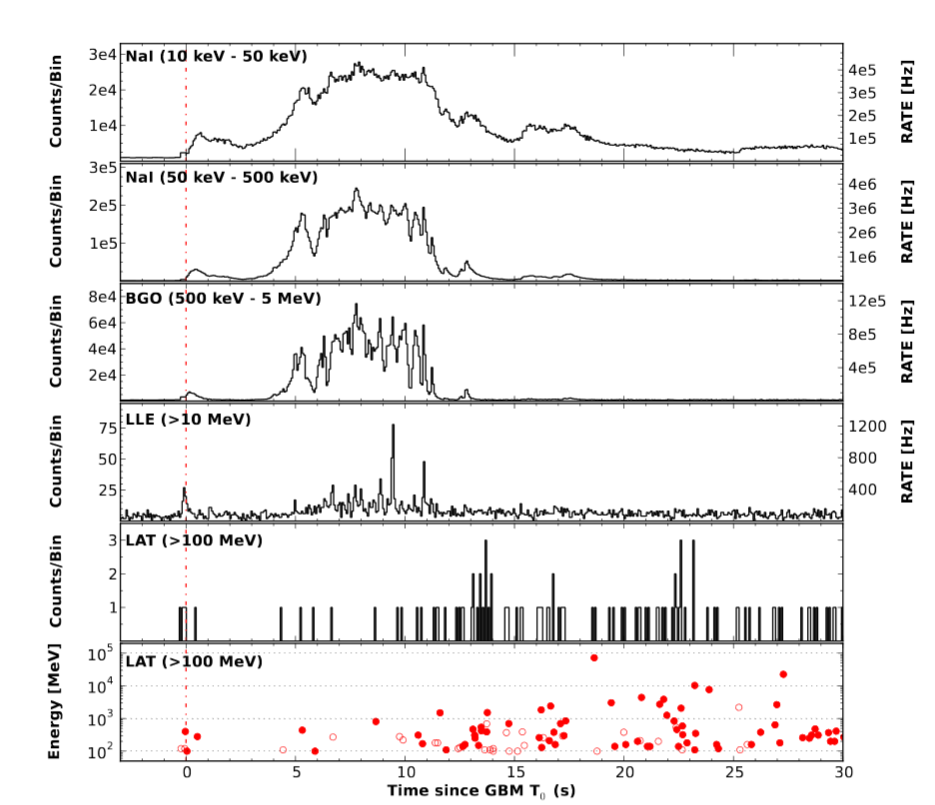
Preece 2013 GRB 130427A的前三秒

主要内容:


精彩摘抄:


文章信息:
· Find Similar Abstracts (with default settings below)
· arXiv e-print (arXiv:1311.5581)
· References in the Article
· Citations to the Article (2) (Citation History)
· Refereed Citations to the Article
· Also-Read Articles (Reads History)
·
· Translate This Page
Title:
The First Pulse of the Extremely Bright GRB 130427A: A Test Lab for Synchrotron Shocks
Authors:
Preece, R.; Burgess, J. Michael; von Kienlin, A.; Bhat, P. N.; Briggs, M. S.; Byrne, D.; Chaplin, V.; Cleveland, W.; Collazzi, A. C.; Connaughton, V.; Diekmann, A.; Fitzpatrick, G.; Foley, S.; Gibby, M.; Giles, M.; Goldstein, A.; Greiner, J.; Gruber, D.; Jenke, P.; Kippen, R. M.; Kouveliotou, C.; McBreen, S.; Meegan, C.; Paciesas, W. S.; Pelassa, V.; Tierney, D.; van der Horst, A. J.; Wilson-Hodge, C.; Xiong, S.; Younes, G.; Yu, H.-F.; Ackermann, M.; Ajello, M.; Axelsson, M.; Baldini, L.; Barbiellini, G.; Baring, M. G.; Bastieri, D.; Bellazzini, R.; Bissaldi, E.; Bonamente, E.; Bregeon, J.; Brigida, M.; Bruel, P.; Buehler, R.; Buson, S.; Caliandro, G. A.; Cameron, R. A.; Caraveo, P. A.; Cecchi, C.; Charles, E.; Chekhtman, A.; Chiang, J.; Chiaro, G.; Ciprini, S.; Claus, R.; Cohen-Tanugi, J.; Cominsky, L. R.; Conrad, J.; D'Ammando, F.; de Angelis, A.; de Palma, F.; Dermer, C. D.; Desiante, R.; Digel, S. W.; Di Venere, L.; Drell, P. S.; Drlica-Wagner, A.; Favuzzi, C.; Franckowiak, A.; Fukazawa, Y.; Fusco, P.; Gargano, F.; Gehrels, N.; Germani, S.; Giglietto, N.; Giordano, F.; Giroletti, M.; Godfrey, G.; Granot, J.; Grenier, I. A.; Guiriec, S.; Hadasch, D.; Hanabata, Y.; Harding, A. K.; Hayashida, M.; Iyyani, S.; Jogler, T.; Jóannesson, G.; Kawano, T.; Knödlseder, J.; Kocevski, D.; Kuss, M.; Lande, J.; Larsson, J.; Larsson, S.; Latronico, L.; Longo, F.; Loparco, F.; Lovellette, M. N.; Lubrano, P.; Mayer, M.; Mazziotta, M. N.; Michelson, P. F.; Mizuno, T.; Monzani, M. E.; Moretti, E.; Morselli, A.; Murgia, S.; Nemmen, R.; Nuss, E.; Nymark, T.; Ohno, M.; Ohsugi, T.; Okumura, A.; Omodei, N.; Orienti, M.; Paneque, D.; Perkins, J. S.; Pesce-Rollins, M.; Piron, F.; Pivato, G.; Porter, T. A.; Racusin, J. L.; Rainò, S.; Rando, R.; Razzano, M.; Razzaque, S.; Reimer, A.; Reimer, O.; Ritz, S.; Roth, M.; Ryde, F.; Sartori, A.; Scargle, J. D.; Schulz, A.; Sgrò, C.; Siskind, E. J.; Spandre, G.; Spinelli, P.; Suson, D. J.; Tajima, H.; Takahashi, H.; Thayer, J. G.; Thayer, J. B.; Tibaldo, L.; Tinivella, M.; Torres, D. F.; Tosti, G.; Troja, E.; Usher, T. L.; Vandenbroucke, J.; Vasileiou, V.; Vianello, G.; Vitale, V.; Werner, M.; Winer, B. L.; Wood, K. S.; Zhu, S.
Publication:
eprint arXiv:1311.5581
Publication Date:
11/2013
Origin:
ARXIV
Keywords:
Astrophysics - High Energy Astrophysical Phenomena
Comment:
This is the author's version of the work. It is posted here by permission of the AAAS for personal use, not for redistribution. The definitive version was published online in Science Express on 21 November 2013 [DOI:10.1126/science.1242302] 15 pages, 4 figures and 1 table; includes supplementary online materials; doi:10.1126/science.1242302
Bibliographic Code:
2013arXiv1311.5581P

Abstract

Gamma-ray burst (GRB) 130427A is one of the most energetic GRBs ever observed. The initial pulse up to 2.5 s is possibly the brightest well-isolated pulse observed to date. A fine time resolution spectral analysis shows power-law decays of the peak energy from the onset of the pulse, consistent with models of internal synchrotron shock pulses. However, a strongly correlated power-law behavior is observed between the luminosity and the spectral peak energy that is inconsistent with curvature effects arising in the relativistic outflow. It is difficult for any of the existing models to account for all of the observed spectral and temporal behaviors simultaneously.

Bibtex entry for this abstract   Preferred format for this abstract (see Preferences)