伽玛暴(Gamma-Ray Burst)笔记。记录有关伽玛暴的新文章,另外也包括看的老文章、自己的想法、以及跟天文相关的一些东西。 Feel free to leave me a message by comments or by email.

显示标签为“7.1 selected”的博文。显示所有博文

星期四, 二月 09, 2012

Hascoët, R. 2011 Fermi暴的GeV光子延后是因为早期被吸收

主要内容:
1. 改进光子-光子湮灭模型,使得对Gamma的限制小了几倍;
2. 认为早期对GeV光子来说光深较大,出不来,所以GeV的光子比较晚出来;(有个问题,GeV光子在MeV的没有了的时候还有呢)

从没有到有GeV光子出来,可以知道在什么时候光深为1,从而计算出洛伦兹因子,结果是340左右。

精彩摘抄:


文章信息:
· Find Similar Abstracts (with default settings below)
· Electronic Refereed Journal Article (HTML)
· Full Refereed Journal Article (PDF/Postscript)
· arXiv e-print (arXiv:1107.5737)
· References in the article
· Citations to the Article (6) (Citation History)
· Refereed Citations to the Article
· Also-Read Articles (Reads History)
·
· Translate This Page
Title:
Do Fermi Large Area Telescope observations imply very large Lorentz factors in gamma-ray burst outflows?
Authors:
Hascoët, R.; Daigne, F.; Mochkovitch, R.; Vennin, V.
Affiliation:
AA(UPMC-CNRS, UMR7095, Institut d'Astrophysique de Paris, F-75014 Paris, France), AB(UPMC-CNRS, UMR7095, Institut d'Astrophysique de Paris, F-75014 Paris, France), AC(UPMC-CNRS, UMR7095, Institut d'Astrophysique de Paris, F-75014 Paris, France), AD(UPMC-CNRS, UMR7095, Institut d'Astrophysique de Paris, F-75014 Paris, France)
Publication:
Monthly Notices of the Royal Astronomical Society, Online Early (MNRAS Homepage)
Publication Date:
01/2012
Origin:
WILEY
Astronomy Keywords:
radiation mechanisms: non-thermal, radiative transfer, gamma-ray burst: general, gamma-ray burst: individual: GRB 080916C
Abstract Copyright:
© 2012 The Authors Monthly Notices of the Royal Astronomical Society © 2012 RAS
DOI:
10.1111/j.1365-2966.2011.20332.x
Bibliographic Code:
2012MNRAS.tmp.2225H

Abstract

Recent detections of GeV photons in a few gamma-ray bursts (GRBs) by Fermi Large Area Telescope (LAT) imply huge bulk Lorentz factors to avoid a large γγ optical depth at high energy. Estimates can be as high as Γ≃ 103 in the most extreme cases. This puts severe constraints on models of the central engine and the jet acceleration in GRBs. These estimates are, however, obtained from a simplified single-zone model. We present here a more realistic calculation of the γγ opacity which takes into account the time, space and direction dependent photon field existing in an outflow with several relativistically moving emitting zones. The formalism is very general and can be applied to many models of the prompt GRB emission. We present results obtained for a numerical implementation in the framework of the internal shock model. We show the following results in this paper. (i) The minimum Lorentz factor Γmin in bright Fermi-LAT GRBs is reduced by a factor of ≃2-3 compared to previous estimates if the GeV and MeV emission are produced in the same region, and by an additional factor of ≃2-8 if the GeV emission is produced at larger radii. We provide an improved approximate formula for Γmin which is in good agreement with our numerical results and which can be directly applied to Fermi-LAT GRB data. (ii) A delayed onset of the GeV emission can be due to the time evolution of the opacity in a GRB outflow. As an illustration of these first two results, we present a synthetic GRB that reproduces most features of GRB 080916C with a mean Lorentz factor of ≃340, an optically thin regime for γγ opacity at 3 GeV in time bin 'b', a variability time-scale of ≃0.5 s in the MeV light curve and a delayed onset of ≃5 s of the GeV emission. (iii) The γγ opacity can smooth the short time-scale variability in the GeV light curve. This last result implies that the observed variability at high energy is not necessarily a good test to distinguish between an internal and an external origin for the GeV emission in GRBs.
Bibtex entry for this abstract   Preferred format for this abstract (see Preferences)

星期二, 二月 07, 2012

Nemiroff, Robert J. 2011 可以用一个简单的唯象公式来拟合pulse的光变

主要内容:
就是这个公式

做到了参数少又能很好的拟合,其中应该有什么原因。

精彩摘抄:
拟合的参数:

拟合的光变:


文章信息:
· Find Similar Abstracts (with default settings below)
· Electronic Refereed Journal Article (HTML)
· Full Refereed Journal Article (PDF/Postscript)
· arXiv e-print (arXiv:1109.3376)
· References in the article
· Also-Read Articles (Reads History)
·
· Translate This Page
Title:
Extension of an exponential light-curve gamma-ray burst pulse model across energy bands
Authors:
Nemiroff, Robert J.
Affiliation:
AA(Department of Physics, Michigan Technological University, Houghton, MI 49931, USA)
Publication:
Monthly Notices of the Royal Astronomical Society, Volume 419, Issue 2, pp. 1650-1659. (MNRAS Homepage)
Publication Date:
01/2012
Origin:
WILEY
Astronomy Keywords:
gamma-ray burst: general
Abstract Copyright:
© 2011 The Author Monthly Notices of the Royal Astronomical Society © 2011 RAS
DOI:
10.1111/j.1365-2966.2011.19838.x
Bibliographic Code:
2012MNRAS.419.1650N

Abstract

A simple mathematical model of gamma-ray burst(GRB) pulses in time, suggested by Norris et al., is extended across energy. For a class of isolated pulses, two fit parameters appear to be effectively independent of energy. Specifically, statistical fits indicate that pulse amplitude A and pulse width τ are energy dependent, while pulse start time and pulse shape are effectively energy independent. These results bolster the pulse start and pulse scale conjectures of Nemiroff and add a new pulse shape conjecture which states that a class of pulses all have the same shape. The simple resulting pulse counts model is P(t, E) =A(E) exp[ -t/τ(E) -τ(E)/t], where t is the time since the start of the pulse. This pulse model is found to be an acceptable statistical fit to many of the fluent separable Burst and Transient Source Experiment (BATSE) pulses listed by Norris et al. Even without theoretical interpretation, this cross-energy extension may be immediately useful for fitting prompt emission from GRB pulses across energy channels with a minimal number of free parameters.
Bibtex entry for this abstract   Preferred format for this abstract (see Preferences)

星期日, 二月 05, 2012

Lazzati, Davide 2011 用中心引擎的持续时间来分类伽马暴Ibc型超新星等

主要内容:
假设中心引擎的持续时间就是能产生喷流的时间,考虑到喷流还要穿过恒星包层,那么喷流时间最长的能产生正常的长伽马暴;中等长度的只能产生如GRB 980425样的弱伽马暴;短的只产生超新星,不过这种超新星的速度蛮快的;最短的,就只有一个一般的超新星,而没有任何伽马暴的特征了。

精彩摘抄:


文章信息:
· Find Similar Abstracts (with default settings below)
· arXiv e-print (arXiv:1111.0970)
· References in the Article
· Citations to the Article (1) (Citation History)
· Refereed Citations to the Article
· Also-Read Articles (Reads History)
·
· Translate This Page
Title:
Unifying the Zoo of Jet-Driven Stellar Explosions
Authors:
Lazzati, Davide; Morsony, Brian J.; Blackwell, Christopher H.; Begelman, Micthell C.
Publication:
eprint arXiv:1111.0970
Publication Date:
11/2011
Origin:
ARXIV
Keywords:
Astrophysics - High Energy Astrophysical Phenomena, Astrophysics - Cosmology and Extragalactic Astrophysics, Astrophysics - Solar and Stellar Astrophysics
Comment:
8 pages, 5 figures, submitted to ApJL. Full resolution version of Fig. 1 available at http://grb.physics.ncsu.edu/ms_hr.pdf
Bibliographic Code:
2011arXiv1111.0970L

Abstract

We present a set of numerical simulations of stellar explosions induced by relativistic jets emanating from a central engine sitting at the center of compact, dying stars. We explore a wide range of durations of the central engine activity, two candidate stellar progenitors, and two possible values of the total energy release. We find that even if the jets are narrowly collimated, their interaction with the star unbinds the stellar material, producing a stellar explosion. We also find that the outcome of the explosion can be very different depending on the duration of the engine activity. Only the longest-lasting engines result in successful gamma-ray bursts. Engines that power jets only for a short time result in relativistic supernova explosions, akin to observed engine-driven SNe such as SN2009bb. Engines with intermediate durations produce weak gamma-ray bursts, with properties similar to nearby bursts such as GRB 980425. Finally, we find that the engines with the shortest durations, if they exist in nature, produce stellar explosions that lack sizable amounts of relativistic ejecta and are therefore dynamically indistinguishable from ordinary core-collapse supernovae.

Bibtex entry for this abstract   Preferred format for this abstract (see Preferences)

星期六, 二月 04, 2012

Bromberg, Omer 2011 伽马暴坍缩星模型的一个证据

主要内容:
下图的平台是证据。考虑到喷流冲出包层需要时间,只有冲出后的时间才被当做T90.这就相当于X射线shellow decay的时间零点移动模型一样。那么在时间短的那些暴满足的power law的分布应该是(T90+tau)^-alpha,换成T90^-beta就有一个平台。
更短的地方的突起就不应该是坍缩星的,而是另一类,短暴。


精彩摘抄:


文章信息:
· Find Similar Abstracts (with default settings below)
· arXiv e-print (arXiv:1111.2990)
· References in the Article
· Citations to the Article (2) (Citation History)
· Refereed Citations to the Article
· Also-Read Articles (Reads History)
·
· Translate This Page
Title:
An observational imprint of the Collapsar model of long Gamma Ray Bursts
Authors:
Bromberg, Omer; Nakar, Ehud; Piran, Tsvi; Sari, Re'em
Publication:
eprint arXiv:1111.2990
Publication Date:
11/2011
Origin:
ARXIV
Keywords:
Astrophysics - High Energy Astrophysical Phenomena
Comment:
12 pages, 1 figure
Bibliographic Code:
2011arXiv1111.2990B

Abstract

The Collapsar model provides a theoretical framework for the well known association between long gamma-ray bursts (GRBs) and collapsing massive stars. A bipolar relativistic jet, launched at the core of a collapsing star, drills its way through the stellar envelope and breaks out of the surface before producing the observed gamma-rays. While a wealth of observations associate GRBs with the death of massive stars, as yet there is no direct evidence for the Collapsar model itself. Here we show that a distinct signature of the Collapsar model is the appearance of a plateau in the duration distribution of the prompt GRB emission at times much shorter than the typical breakout time of the jet. This plateau is evident in the data of all three major satellites. These findings provide an evidence that directly supports the Collapsar model. Additionally, it suggests the existence of a large population of choked (failed) GRBs and that the 2 s duration commonly used to separate Collapsars and non-Collapasars is inconsistent with the duration distributions of {\it Swift} and Fermi GRBs and only holds for BATSE GRBs.
Bibtex entry for this abstract   Preferred format for this abstract (see Preferences)

Qi, Shi 2011 E_p-tau_RT-L关系

主要内容:
在多个关系里找一个致密的关系。
(方法可以借鉴,没有提供具体的数据)

精彩摘抄:

多个关系


找到了一个较致密的关系


文章信息:
· Find Similar Abstracts (with default settings below)
· arXiv e-print (arXiv:1111.6249)
· References in the Article
· Also-Read Articles (Reads History)
·
· Translate This Page
Title:
Toward tight gamma-ray burst luminosity relations
Authors:
Qi, Shi; Lu, Tan
Publication:
eprint arXiv:1111.6249
Publication Date:
11/2011
Origin:
ARXIV
Keywords:
Astrophysics - Cosmology and Extragalactic Astrophysics, Astrophysics - High Energy Astrophysical Phenomena
Comment:
8 pages, 1 figure, 1 table
Bibliographic Code:
2011arXiv1111.6249Q

Abstract

The large scatters of luminosity relations of gamma-ray bursts (GRBs) have been one of the most important reasons that prevent the extensive applications of GRBs in cosmology. Many efforts have been made to seek tight luminosity relations. With the latest sample of 116 GRBs, we investigated 6 two-dimensional (2D) correlations and 14 derived three-dimensional (3D) correlations of GRBs to explore the possibility of decreasing the intrinsic scatters of the luminosity relations of GRBs. We found the 3D correlation of $E_{\mathrm{peak}}$--$\tau_{\mathrm{RT}}$--$L$ to be significantly tighter (at $2 \sigma$ confidence level) than its corresponding 2D correlations, i.e., the $E_{\mathrm{peak}}$--$L$ and $\tau_{\mathrm{RT}}$--$L$ correlation. In addition, the coefficients before the logarithms of $E_{\mathrm{peak}}$ and $\tau_{\mathrm{RT}}$ in the $E_{\mathrm{peak}}$--$\tau_{\mathrm{RT}}$--$L$ correlation are almost exactly opposite to each other. Inputting this situation as a prior reduces the relation to $L \propto (E_{\mathrm{peak}}^{'} / \tau_{\mathrm{RT}}^{'})^{0.842 \pm 0.064}$, where $E_{\mathrm{peak}}^{'}$ and $\tau_{\mathrm{RT}}^{'}$ denote the peak energy and minimum rise time in the GRB rest frame. We discussed that what we found can be interpreted/understood in the framework of the definition of the luminosity (energy released in units of time). Our argument about the connection between the luminosity relations of GRBs and the definition of the luminosity provides a clear direction for exploring tighter luminosity relations of GRBs in the future.

Bibtex entry for this abstract   Preferred format for this abstract (see Preferences)

星期四, 二月 02, 2012

Collazzi, Andrew C. 2011 Amati关系仅仅是由于选择效应导致的

主要内容:
不过并没有导致其他包含光度的关系的实效。

第一次有人这么大动干戈地反驳Amati关系。

精彩摘抄:
基本上这个图说明一切。


文章信息:
· Find Similar Abstracts (with default settings below)
· arXiv e-print (arXiv:1112.4347)
· References in the Article
· Also-Read Articles (Reads History)
·
· Translate This Page
Title:
A Significant Problem With Using the Amati Relation for Cosmological Purposes
Authors:
Collazzi, Andrew C.; Schaefer, Bradley E.; Goldstein, Adam; Preece, Robert D.
Publication:
eprint arXiv:1112.4347
Publication Date:
12/2011
Origin:
ARXIV
Keywords:
Astrophysics - High Energy Astrophysical Phenomena
Comment:
39 pages, 14 figures, 1 table, ApJ Accepted
Bibliographic Code:
2011arXiv1112.4347C

Abstract

We consider the distribution of many samples of Gamma-Ray Bursts (GRBs) when plotted in a diagram with their bolometric fluence (Sbolo) versus the observed photon energy of peak spectral flux (Epeak,obs). In this diagram, bursts that obey the Amati relation must lie above some limiting line, although observational scatter is expected to be substantial. We confirm that early bursts with spectroscopic redshifts are consistent with this limit. But, we find that the bursts from BATSE, Swift, Suzaku, and Konus are all greatly in violation of the limit. In the Sbolo-Epeak,obs diagram, we find that every satellite has a greatly different distribution. This requires that selection effects are dominating these distributions, which we identify. For detector selections, the trigger threshold and the threshold to measure Epeak,obs combine to make a diagonal cutoff with the position of this cutoff varying greatly detector to detector. For selection effects due to the intrinsic properties of the burst population, the distribution of Epeak,obs makes for bursts with low and high values to be rare, while the fluence distribution makes bright bursts uncommon. For a poor threshold, the combination of selection effects serves to allow only bursts within a region along the limit to be measured; these bursts will then appear to follow an Amati relation. Therefore, the Amati relation is an artifact of selection effects within the burst population and the detector. Therefore, the Amati relation should not be used for cosmological tasks. This failure is in no way prejudicial against the other luminosity relations.
Bibtex entry for this abstract   Preferred format for this abstract (see Preferences)

星期三, 二月 01, 2012

Wilson-Hodge, Colleen A. 2012 GBM三年catalog

主要内容:
209个源,不包括伽马暴。
网址:http://heastro.phys.lsu.edu/gbm/

精彩摘抄:


文章信息:

· Find Similar Abstracts (with default settings below)
· arXiv e-print (arXiv:1201.3585)
· References in the Article
· Also-Read Articles (Reads History)
·
· Translate This Page
Title:
Three years of Fermi GBM Earth Occultation Monitoring: Observations of Hard X-ray/Soft Gamma-Ray Sources
Authors:
Wilson-Hodge, Colleen A.; Case, Gary L.; Cherry, Michael L.; Rodi, James; Camero-Arranz, Ascension; Jenke, Peter; Chaplin, Vandiver;Beklen, Elif; Finger, Mark; Bhat, Narayan; Briggs, Michael S.; Connaughton, Valerie; Greiner, Jochen; Kippen, R. Marc;Meegan, Charles A.; Paciesas, William S.; Preece, Robert; von Kienlin, Andreas
Publication:
eprint arXiv:1201.3585
Publication Date:
01/2012
Origin:
ARXIV
Keywords:
Astrophysics - High Energy Astrophysical Phenomena
Comment:
53 pages, 12 figures, submitted to ApJS
Bibliographic Code:
2012arXiv1201.3585W

Abstract

The Gamma ray Burst Monitor (GBM) on board Fermi has been providing continuous data to the astronomical community since 2008 August 12. In this paper we present the results of the analysis of the first three years of these continuous data using the Earth occultation technique to monitor a catalog of 209 sources. From this catalog, we detect 102 sources, including 41 low-mass X-ray binary/neutron star systems, 33 high-mass X-ray binary neutron star systems, 12 black hole binaries, 12 active galaxies, 2 other sources, plus the Crab Nebula, and the Sun. Nine of these sources are detected in the 100-300 keV band, including seven black-hole binaries, the active galaxy Cen A, and the Crab. The Crab and Cyg X-1 are also detected in the 300-500 keV band. GBM provides complementary data to other sky-monitors below 100 keV and is the only all-sky monitor above 100 keV. Up-to-date light curves for all of the catalog sources can be found at http://heastro.phys.lsu.edu/gbm/.
Bibtex entry for this abstract   Preferred format for this abstract (see Preferences)

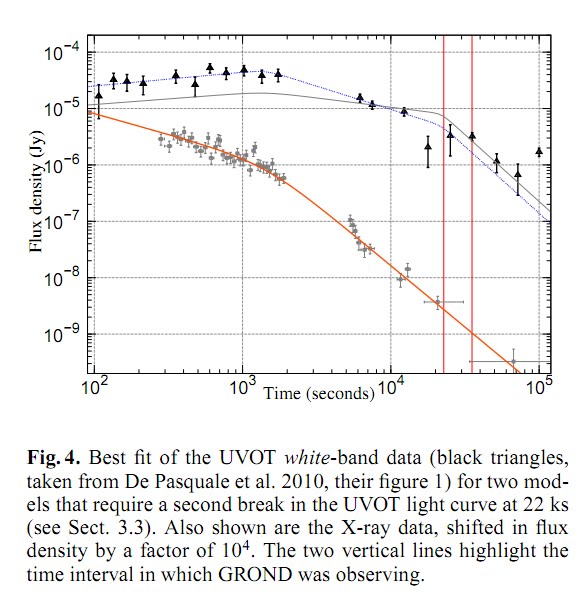
Nicuesa Guelbenzu, A. 2012 GRB090510的晚期余辉观测

主要内容:


精彩摘抄:

X射线和UVOT的观测。从拐折的时间上来看,很有可能第一个拐折是jet break,而第二个是频率穿过,穿过之后二者的时间指数就一样了,因为它们在同一个频率段。文章中并没有提到这个。


光学余辉


文章信息:
· Find Similar Abstracts (with default settings below)
· arXiv e-print (arXiv:1201.3885)
· References in the Article
· Also-Read Articles (Reads History)
·
· Translate This Page
Title:
The late-time afterglow of the extremely energetic short burst GRB 090510 revisited
Authors:
Nicuesa Guelbenzu, A.; Klose, S.; Kruehler, T.; Greiner, J.; Rossi, A.; Kann, D. A.; Olivares E., F.; Rau, A.; Afonso, P. M. J.;Elliott, J.; Filgas, R.; Kuepcue Yoldas, A.; McBreen, S.; Nardini, M.; Schady, P.; Schmidl, S.; Sudilovsky, V.; Updike, A. C.;Yoldas, A.
Publication:
eprint arXiv:1201.3885
Publication Date:
01/2012
Origin:
ARXIV
Keywords:
Astrophysics - High Energy Astrophysical Phenomena
Comment:
submitted to Astronomy & Astrophysics, accepted for publication on Dec 24, 2011
Bibliographic Code:
2012arXiv1201.3885N

Abstract

The discovery of the short GRB 090510 has raised considerable attention mainly because it had a bright optical afterglow and it is among the most energetic events detected so far within the entire GRB population. The afterglow was observed with swift/UVOT and swift/XRT and evidence of a jet break around 1.5 ks after the burst has been reported in the literature, implying that after this break the optical and X-ray light curve should fade with the same decay slope. As noted by several authors, the post-break decay slope seen in the UVOT data is much shallower than the steep decay in the X-ray band, pointing to an excess of optical flux at late times. We reduced and analyzed new afterglow light-curve data obtained with the multichannel imager GROND. Based on the densely sampled data set obtained with GROND, we find that the optical afterglow of GRB 090510 did indeed enter a steep decay phase starting around 22 ks after the burst. During this time the GROND optical light curve is achromatic, and its slope is identical to the slope of the X-ray data. In combination with the UVOT data this implies that a second break must have occurred in the optical light curve around 22 ks post burst, which, however, has no obvious counterpart in the X-ray band, contradicting the interpretation that this could be another jet break. The GROND data provide the missing piece of evidence that the optical afterglow of GRB 090510 did follow a post-jet break evolution at late times.
Bibtex entry for this abstract   Preferred format for this abstract (see Preferences)